4 February 2026 · 7 min read
Small Models Are Not a Compromise. They Are the Only Sane Way to Ship AI to the Edge.
Edge AI fails less on intelligence and more on operations. If you cannot version, test, and service the model like firmware, you do not have a product.
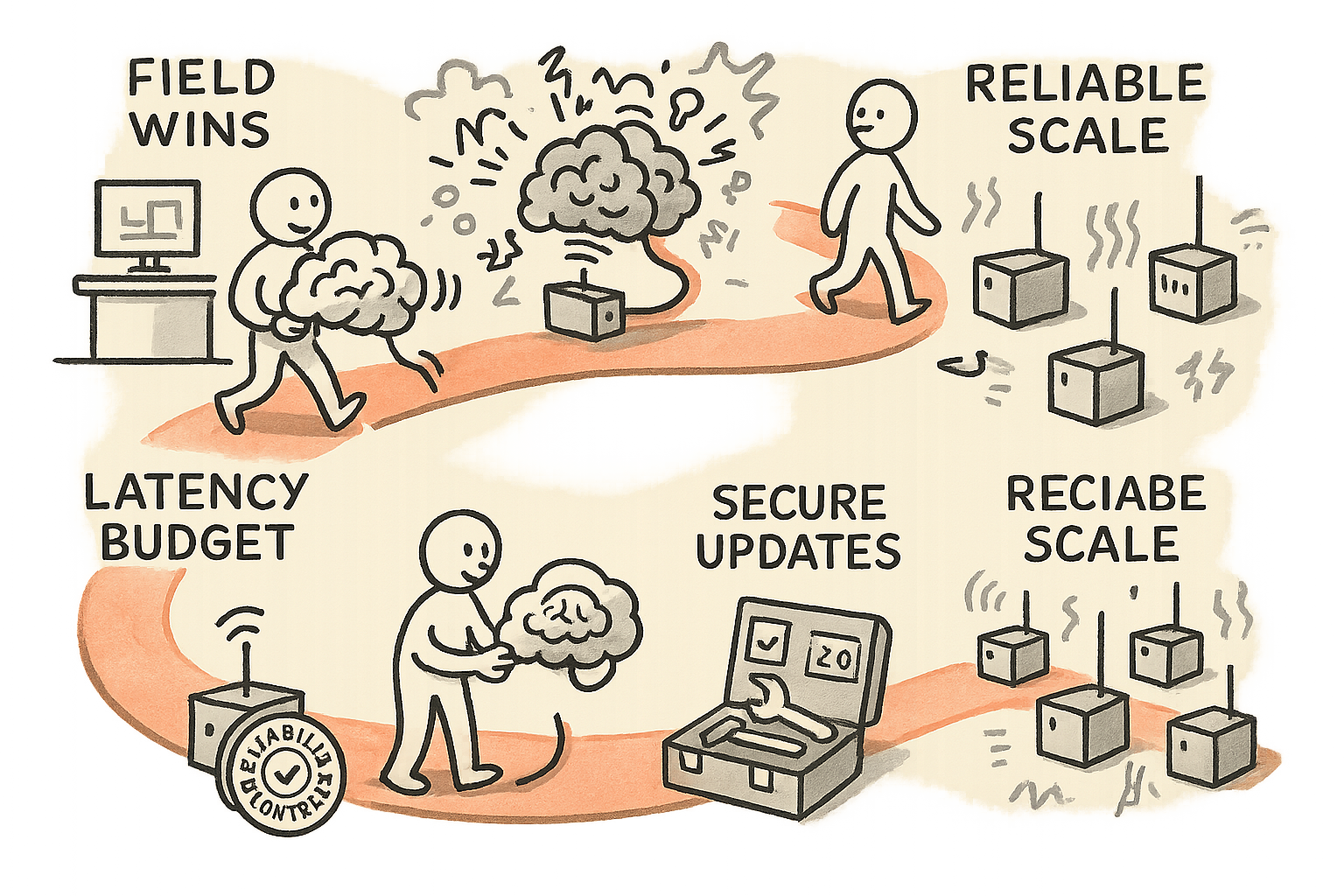
I have shipped systems that lived in the real world, not in notebooks. In industrial tech and connected devices, the field always wins. Temperature, vibration, bad Wi‑Fi, flaky cellular, swapped sensors, and an installer who is rushing because the site manager wants the line running.
That is why I do not see small models as a compromise. I see them as the only sane approach when you want AI to run at the edge, at scale. Not because “small is beautiful,” but because edge deployments are operational products. Your constraints are latency, power, thermals, certification, and service. Cloud inference is sometimes useful, but it drags in cost variability, compliance exposure, and dependency risk that most device businesses underestimate.
The real blueprint is not “pick a smaller model.” The blueprint is: design for field operations from day one. Model versioning, rollback, device-by-device QA, calibration drift, and incident response become part of your release process. If you cannot prove model behavior across firmware, sensors, and environments, you do not have an edge deployment. You have a demo.
The edge is not a deployment target. It is a reliability contract.
Boards and operators often frame edge AI as an architecture choice. Cloud versus device. Big model versus small model. In practice, it is a reliability contract you sign with the customer.
When I ran R&D and quality for connected controls and embedded devices, the hardest problems were rarely the algorithms. They were the interfaces between disciplines: electronics tolerances meeting firmware timing, sensors drifting over seasons, installers mixing hardware revisions, and cloud connectivity behaving differently across countries. Edge AI amplifies that. You are adding a probabilistic component into a deterministic stack.
So I start with three questions that are operational, not academic:
- Is latency a product requirement? If the device must respond within a tight window, the network is not an input, it is a liability.
- Is connectivity a risk? Not “can it connect,” but “can it connect in every customer environment, forever,” including cost and roaming surprises.
- Is cloud inference a compliance and cost problem? Data locality, customer contracts, and variable inference bills do not get friendlier after you scale.
If you answer yes to any of these, the default should be on-device inference with the smallest model that meets the requirement, plus a disciplined operating model around it.
The operator’s fallacy: model choice is the easy part
Teams celebrate when they get an on-device model to run. That moment feels like the breakthrough. It is not. It is the start of the hard work.
The real work is turning that model into something you can manufacture, install, update, and support for years. This is where small models win again. Not because they are “less capable,” but because they are operable. Smaller footprints make it easier to:
- fit into constrained memory and compute budgets without heroic hardware cost,
- ship updates safely (including A/B slots and rollback),
- test across more combinations of firmware and device variants,
- control power draw and thermal behavior under worst-case conditions.
In manufacturing-minded organizations, we understand this intuitively. Complexity is cost. Complexity is defects. Complexity is service tickets. You can sometimes buy performance. You always pay for complexity.
Design edge AI like you design firmware: versioned, testable, rollbackable
My baseline is simple: if your AI cannot live inside the same discipline as firmware, it will not survive the field.
When I rebuilt and scaled an R&D organization (embedded, cloud, electronics, mechanics, QA), we made progress when we treated releases as systems, not as components. The same mindset applies to edge AI. The model is not “a file.” It is a release artifact with dependencies.
Here is the checklist I use with teams. If you cannot answer these cleanly, pause the rollout.
1) Define the runtime contract
- Inputs: sensor types, sampling rates, units, valid ranges, missing-data behavior.
- Pre-processing: normalization, filtering, windowing, feature extraction, and where it runs (MCU, application processor, gateway).
- Outputs: classes, scores, confidence, and what the downstream control logic is allowed to do with them.
Edge failures often come from contract drift. A firmware update changes sampling timing, and the model performance collapses without anyone noticing.
2) Treat model, firmware, and hardware as a tested triplet
- Maintain an explicit compatibility matrix: hardware revision, sensor BOM variant, firmware version, model version.
- Gate releases on system tests, not just model metrics.
- Run worst-case environmental tests that match the product reality, not lab comfort.
This is where most “edge AI” programs break. They test the model in isolation, then ship it into a different universe.
3) Make rollback a first-class product feature
- A/B deployment slots and atomic updates.
- Clear health signals to decide when to auto-rollback.
- A safe mode that preserves core device functionality if the AI component misbehaves.
If you cannot rollback, you cannot be aggressive in learning. And if you cannot learn, you cannot compete.
4) Build device-by-device observability that respects constraints
- Log the minimum viable signals: model version, input health, confidence distributions, decision frequency, latency, and error codes.
- Use sampling strategies, not firehose telemetry, so you can afford it at scale.
- Design for offline buffering and delayed uploads.
Edge AI without observability is guessing. Guessing becomes outages, and outages become churn.
Calibration drift is not an edge case. It is the normal case.
In industrial environments, drift is reality. Sensors age. Installations differ. Sites get refurbished. Firmware settings get tweaked. The world changes faster than your training set.
In my years in power electronics and automation contexts, we respected the fact that physical systems degrade and vary. You do not fight that with hope. You fight it with calibration discipline and clear operating boundaries.
For edge AI, that means you need an explicit strategy for drift:
- Detect: define drift signals you can measure on-device (distribution shifts, rising uncertainty, rising rejection rates).
- Respond: choose actions that are safe (fallback rules, request human confirmation, degrade gracefully).
- Recover: plan how updated models are validated, staged, and deployed back to the fleet.
Most teams obsess over accuracy. Operators should obsess over failure modes. What happens when the model is wrong, or when it does not know? That answer determines whether edge AI is a feature or a liability.
The hidden P&L: service will dwarf your inference savings if you let it
Edge AI is often justified as “cheaper than the cloud.” That can be true on inference cost. But it can be dangerously misleading on total cost of ownership.
When I owned P&L for an international connected-device business unit, I learned to look past the unit economics that fit in a slide. The killer is service. Monitoring, secure updates, incident response, customer escalations, field replacements, and recertification cycles can eat your margin quietly.
So I force a P&L conversation early. Budget the operating reality:
- Secure update infrastructure (signing, key management, staged rollouts).
- Incident response playbooks (who decides rollback, who communicates, what is the SLA).
- Fleet segmentation (different countries, different connectivity profiles, different customer policies).
- Compliance and recertification (what changes trigger re-testing or approval cycles).
If these are not funded, the team will still ship. They will just ship risk into the field, then pay for it later in churn and emergency engineering.
My practical decision lens: edge AI earns its place when it protects time
Here is my opinion, stated plainly. Edge AI is worth it when it protects time: response time, operator time, downtime, and time-to-recovery. Small models are the practical tool that makes that protection operable.
In my own venture building work, including building SaaS platforms like IBHQ, I care about leverage. The same logic applies here: what is the minimal capability that produces a reliable business outcome, and what is the simplest system that can carry it for years? On the edge, simplicity wins because every extra dependency becomes a service event.
If you want to ship edge AI this quarter, do not start with model size. Start with operating discipline. If you need a concrete next step, audit your program against two “contracts”:
- The runtime contract: inputs, outputs, dependencies, compatibility matrix.
- The service contract: update safety, observability, rollback, and incident ownership.
If either contract is vague, you are not ready to scale. Fix that, and small models stop looking like a compromise. They become what they are: the only sane way to ship AI to the edge, at scale, without turning your service organization into your largest engineering team.
Related operational angles: ruggedization as a reliability contract, and why connectivity is a trust anchor with P&L consequences.
Newsletter
Working notes, straight to your inbox.
Occasional, no-noise notes on leadership, execution, and applied AI — from the field, not the sidelines.