21 January 2026 · 7 min read
eSIM Isn’t Connectivity. It’s the Trust Anchor Your IoT P&L Forgot to Budget For.
If you treat identity, provisioning, and ownership as afterthoughts, you will pay for it in truck rolls, SKU chaos, and security exceptions that never close.
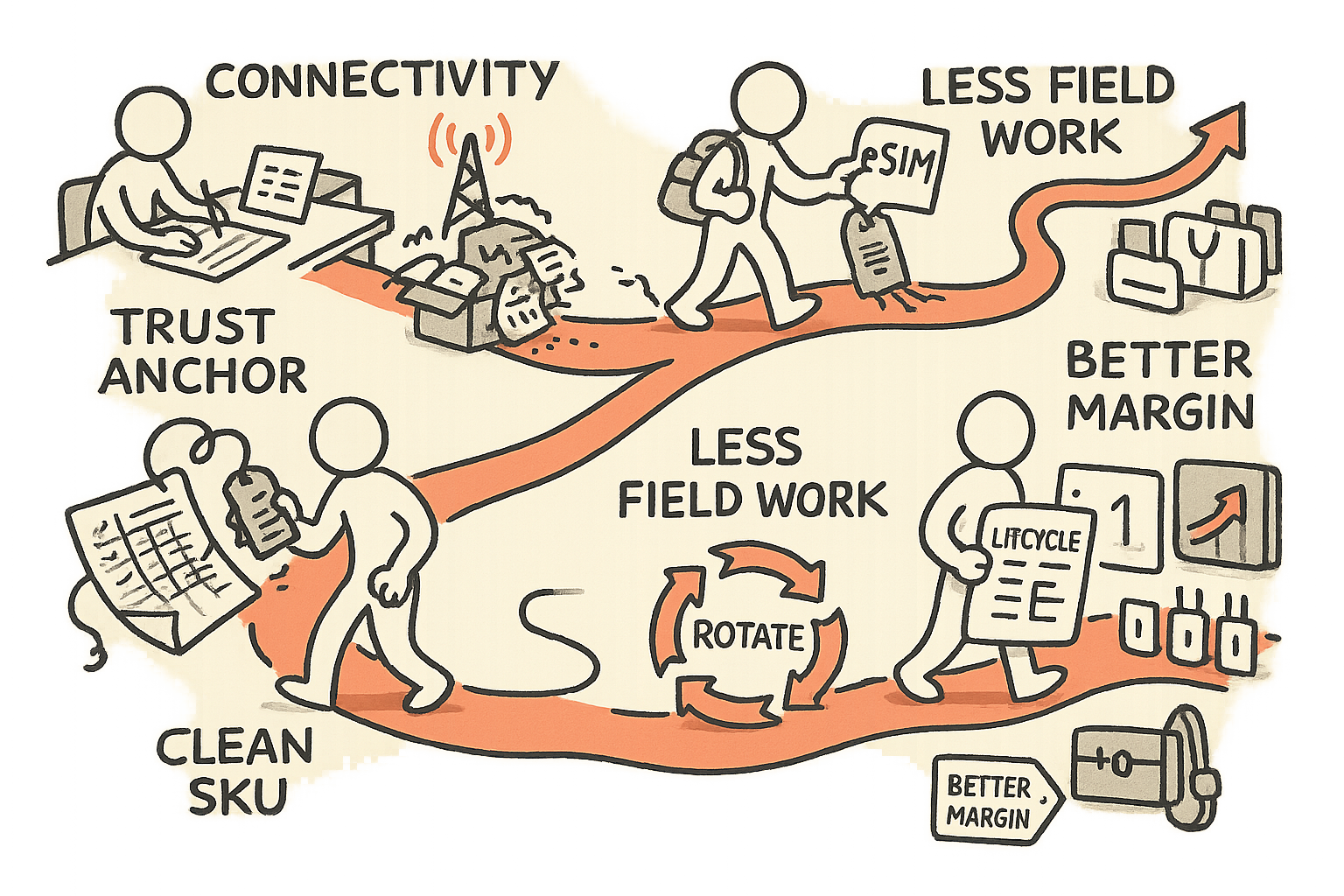
I have watched too many IoT portfolios bleed margin in the same place: not in the sensor BOM, not in the cloud bill, and not even in the initial carrier contract. The leak sits in the messy middle between a device and a network, where identity, ownership, and policy should live, but usually do not.
Teams call it “connectivity.” In reality, it is the control plane of your fleet. It decides who the device is, what it is allowed to do, when it is allowed to do it, and how you recover when something changes. If you do not design that layer up front, you end up running an informal, manual operating system made of spreadsheets, support scripts, and field-service heroics.
My view is simple: eSIM is evolving from a subscriber identity mechanism into a practical trust anchor for IoT. Not in a theoretical security sense. In an operator sense. It turns device lifecycle into a managed process: provisioning, ownership transfer, credential rotation, suspension, reactivation, and decommissioning. It also forces a cleaner commercial and SKU strategy because network and policy can follow the device instead of being baked into hardware and logistics.
When I ran a connected smart-building business unit with products deployed across multiple countries, I kept chasing the same operational leverage: fewer variants, fewer exceptions, faster recovery, and less dependence on a technician with a screwdriver. eSIM, treated correctly, is one of the few levers that touches all of those at once.
The hidden cost center: lifecycle operations, not “SIM management”
Most IoT businesses treat connectivity as procurement. Choose a carrier, choose a plan, put a SIM in the box. Then reality arrives:
- A device is installed in the wrong site and must be moved to a different customer.
- A distributor pre-activates inventory to “help,” then you inherit aging subscriptions.
- A carrier has coverage gaps in a region where you now have contractual uptime expectations.
- A technician swaps hardware because “it does not connect,” when the issue is identity or provisioning.
- A customer changes ownership structure and wants access boundaries updated yesterday.
Each of these becomes expensive when your identity and policy layer is not designed for change. The cost does not show up as a line item called “missing trust anchor.” It shows up as:
- Truck rolls and revisits that should have been remote actions.
- Support tickets that never fully close because root cause is unclear.
- Inventory write-offs due to country-specific variants.
- Security risk accepted as “operational reality.”
My operator framing is: if it can happen more than once, it is a process. If it is a process, it needs ownership, metrics, and tooling. eSIM is not the whole answer, but it can be the anchor that makes the process enforceable.
eSIM as a trust anchor: what changes in the operating model
When connectivity becomes remotely switchable and cryptographically governed, you stop thinking in terms of “the SIM card” and start thinking in terms of “the identity lifecycle.” That shift matters because it changes where you place controls.
1) Provisioning becomes a first-class workflow
In many fleets, provisioning is treated like a manufacturing step. It is done once, then forgotten. But fleets live for years, across regions, customers, installers, and ownership changes. Provisioning must be repeatable and reversible.
With eSIM, you can design provisioning as a controlled workflow that ties together:
- Device identity: what the device is.
- Network policy: where it can connect and under what rules.
- Application access: what cloud endpoints and credentials it is allowed to use.
- Commercial state: who pays, who owns, and what service tier applies.
That is not “IT.” That is your product.
2) Ownership transfer stops being a field problem
Ownership transfer is where many IoT business models quietly break. Devices move between sites, tenants change, integrators churn, and asset managers rotate portfolios. If your product cannot cleanly transfer ownership, you will either block revenue or accept security exceptions.
eSIM makes it realistic to design a controlled ownership transfer that includes connectivity state, not just app-level permissions. The practical outcome is fewer dead devices sitting on shelves because “we cannot reassign it,” and fewer cases where a former installer still has implicit access because nobody wanted to touch the connectivity layer.
3) Credential rotation and decommissioning become enforceable
In industrial and building environments, devices live long enough that credentials must rotate and policies must evolve. When I spent years in power electronics and automation, I learned to respect long lifecycle products. You do not get to “move fast” when a device is bolted into a panel in a wastewater plant or installed in a commercial building ceiling.
Long life means the messy tasks matter: rotate credentials, revoke access, and decommission cleanly. A trust anchor makes those tasks part of normal operations, not an emergency response after an incident.
The SKU strategy benefit: fewer variants, more software-defined product
One of the most underappreciated benefits of taking eSIM seriously is what it does to your SKU discipline.
IoT companies often accumulate regional variants because connectivity differences leak into hardware, packaging, and logistics. Different SIMs, different carriers, different certifications, different default configurations. The result is a warehouse full of complexity and a planning team that cannot stop firefighting.
When network and policy can follow the device, you can move toward:
- Fewer hardware SKUs that cover more markets.
- Late binding of connectivity profiles during fulfillment or install.
- Software-defined configurations that are controlled, versioned, and auditable.
That is not just elegance. It is working capital, forecast accuracy, and fewer expensive mistakes.
This connects to how I think about reliability in physical products. Ruggedization, quality gates, and lifecycle discipline are contracts you pay for and enforce. If this is relevant to your hardware business, I laid out my broader view in Ruggedization Isn’t a Checkbox. It’s a Reliability Contract You Pay For and Enforce.
The board-level lens: treat eSIM as an operating system cost
If you are a board member or an operator, the decision is not “should we use eSIM.” The decision is “are we budgeting and governing identity and connectivity lifecycle as an operating system.” Here is the lens I use.
Ask these five questions this quarter
- Who owns the device identity lifecycle end-to-end? Not IT. Not support. One accountable owner across product, operations, and security.
- Can we re-provision a device remotely, at scale, with auditability? If the answer involves manual support steps, you do not have a process yet.
- Can we transfer ownership in minutes without creating security debt? If it takes days, your churn and resale story is weaker than you think.
- Do we have a defined decommissioning procedure? Including revocation, data retention rules, and proof that access is terminated.
- Is our SKU strategy driven by customer value or by historical carrier constraints? If inventory complexity is rising, you are paying tax for poor late binding.
Measure what matters: three metrics I would put on the dashboard
- Provisioning lead time: from device powered on to fully operational, including policy.
- Connectivity-related truck rolls: count and cost, separated from true hardware failures.
- Time to recover from carrier issues: not the carrier’s SLA, your fleet-level recovery time.
When I built and ran products, I learned that what you measure becomes what you can improve. When you do not measure it, it becomes folklore.
A practical implementation stance: start narrow, enforce hard
There is a trap here. Teams try to “do eSIM” as a broad transformation. They boil the ocean, then stall. I prefer a narrower starting point:
- Pick one device family with real volume and real support pain.
- Define the lifecycle states clearly (manufactured, in inventory, installed, active, suspended, transferred, decommissioned).
- Define who can trigger transitions, and how those actions are audited.
- Ship the minimum tooling to make the workflow repeatable.
Then expand to more SKUs and more regions. This is the same approach I take in my own ventures when building software platforms like Shopeno and IBHQ. Start with a workflow that creates measurable operational leverage, then scale what works.
The non-negotiable part is enforcement. If support can bypass the workflow “just this once,” you will accumulate a second, unofficial system. And unofficial systems always win in the short term, until they bankrupt you in the long term.
In IoT, the product is not only the device and the app. The product is the lifecycle you can operate without heroics.
My closing opinion: stop selling devices, start operating fleets
IoT businesses fail less often from lack of innovation and more often from lack of operating discipline. eSIM, treated as a trust anchor, is one of the cleanest ways to force that discipline into the product. It makes lifecycle states explicit. It makes ownership transfer and credential rotation normal. It reduces SKU chaos. And it changes the economics of field service by removing a category of avoidable visits.
If your IoT P&L is large enough to care about margin, churn, and liability, you are large enough to budget for an identity operating system. eSIM is not a feature. It is the beginning of a control plane. Build it like one.
Newsletter
Working notes, straight to your inbox.
Occasional, no-noise notes on leadership, execution, and applied AI — from the field, not the sidelines.