8 January 2026 · 8 min read
Ruggedization Isn’t a Checkbox. It’s a Reliability Contract You Pay For and Enforce.
If “rugged” is not translated into quantified stress, failure modes, and test ownership, you will ship lab winners that die in the field.
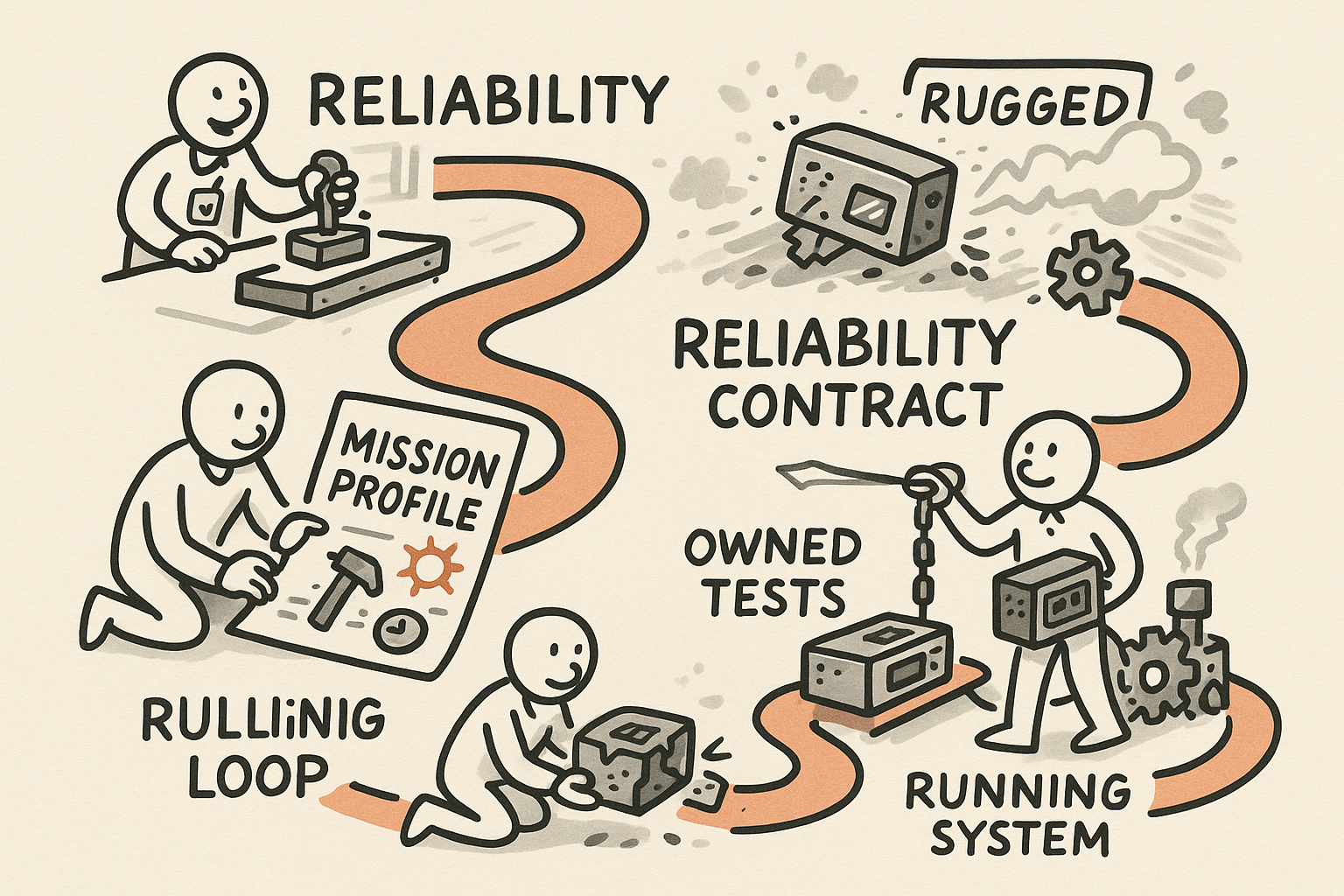
I have seen too many programs do the same painful dance: a product passes qualification in a clean lab, everyone celebrates, then real life happens. The unit gets installed in a harsher environment, handled by a different technician, mounted in a slightly different way, exposed to a duty cycle nobody wrote down, and it starts failing. The postmortem always finds the same root cause. Not “bad luck”. Not even “bad parts”. The root cause is usually governance. “Rugged” was a word, not a contract.
When I led market quality in power electronics for years, and later when I ran R&D and operations for connected devices and industrial systems, I learned to treat reliability like cost. If it is not quantified, owned, and enforced end-to-end, it becomes theater. People optimize for a lab pass because that is what the system rewards. Customers pay for uptime and field life, not for certificates.
Ruggedization is not about making everything “MIL-spec”. That mindset is both expensive and lazy. The operator’s job is to decide where to harden, where to redesign, and where to accept risk, then to prove it with tests that reflect the real mission profile. Anything else is a gamble with a nice PowerPoint cover.
1) Start with a mission profile, not a requirement adjective
“Rugged” is not a requirement. It is a placeholder for a set of stresses over time. If you do not write those stresses down, engineering will guess, test will assume, procurement will substitute, and manufacturing will drift. All rational locally. Disastrous globally.
A mission profile should be explicit enough that two teams on different continents produce the same design and the same test plan. In practice, I want it framed as environment plus usage, then converted into measurable loads:
- Environment: temperature range and ramps, humidity and condensation events, vibration spectrum, shock, dust, chemicals, UV, salt fog, altitude, EMC exposure.
- Usage: duty cycle, power cycling, switching frequency, mechanical actuation count, connector mating cycles, installation torque, maintenance interval, firmware update frequency.
- Constraints: allowed downtime, serviceability, spare strategy, calibration needs, acceptable drift, warranty horizon.
Then I force the next step: translate the profile into quantified failure modes. What fails first, and why, under these stresses? Is it solder fatigue from thermal cycling, connector fretting from vibration, moisture ingress and corrosion, polymer creep, coating delamination, electrolytic capacitor dry-out, or a software watchdog interacting with brownouts? This is where “ruggedization” stops being a mood and becomes an engineering and business decision.
As a former COO responsible for engineering, production, and service in electrification and energy storage, I cared less about the label on a component and more about the life model of the system. Some parts do need uprating. Some need mechanical isolation. Some need a redesign of airflow, sealing, or PCB stack-up. And sometimes the right answer is to narrow the operating envelope and put it in the contract.
2) Put one person in charge of reliability, with real authority
Most field failures are not caused by a lack of competence. They are caused by “ownership-free” interfaces: engineering assumes test will catch it, test assumes requirements are correct, quality assumes suppliers comply, suppliers assume substitutions are acceptable. No single throat to choke, so nobody closes the loop.
The fix is simple and uncomfortable: name a single reliability owner. Not a committee. One accountable leader who controls three things:
- Environment assumptions: the mission profile is baselined and version-controlled. Any change triggers impact review.
- Test matrix: which stresses, what sequence, what sample size logic, what pass-fail criteria, what margins.
- Acceptance rules: what constitutes a releasable design, what waivers exist, and what must be fixed before ramp.
When I rebuilt and scaled an R&D organization across embedded software, cloud, electronics, mechanics, and QA, the fastest reliability improvement came from clarity. Not more tests. Clear ownership and a single definition of “done”. Once reliability had an owner, lab results stopped being an endpoint and became a gate to the next learning cycle.
Give that owner power over priorities and change control. Otherwise you are asking them to be responsible for outcomes without controlling inputs. That is not accountability. That is theater.
3) Decide what to ruggedize, what to redesign, and what to operationalize
“Make it rugged” is often used to avoid a harder decision: where do we spend money, add lead time, and increase complexity, and where do we change the system design or the operating model instead?
I use a simple decision lens that board members and operators can apply in a quarterly review. For each top failure mode, choose one of three strategies:
- Ruggedize the component: uprate parts, change materials, add coating, add mechanical retention, add sealing. This raises unit cost and often lead time, but can be fast if the architecture is right.
- Redesign the system: move heat sources, change layout to reduce CTE mismatch, add isolation, re-route creepage and clearance, add redundancy, change connector strategy, improve drainage and venting. This costs engineering time but can reduce recurring cost and simplify supply risk.
- Operationalize the risk: limit the envelope, add installation constraints, require service intervals, add monitoring, add stress-screening at production, or change packaging and logistics. This is often the cheapest path if the customer context supports it.
The mistake is doing all three blindly. You end up with an overbuilt product that is still fragile because the real stress was never modeled. Or you underbuild and try to patch it with a warranty budget.
In connected sensors and building-controls systems, for example, I saw how “small” installation variability becomes a reliability driver: cable strain, condensation behind a wall, vibration from a nearby compressor, or power quality issues. Sometimes ruggedization was the right choice. Other times the winning move was mechanical redesign and clear installation rules enforced through training and acceptance checks.
4) Treat process recipes like critical components, because they are
Teams tend to treat the bill of materials as sacred and the process as flexible. In rugged products, that is backwards. Coatings, composites, adhesives, potting compounds, curing profiles, surface prep, reflow windows, torque specs, and cleaning steps are not “manufacturing details”. They are reliability features.
So supplier qualification cannot stop at a datasheet. The operator playbook is:
- Lock the recipe: specify material grade, mixing ratio, surface preparation, cure time, cure temperature, and allowable humidity window. Document it like you document a component spec.
- Audit the line: confirm the supplier can measure and control the recipe, not just claim it. If they cannot measure it, they cannot control it.
- Control sub-tiers: define what requires notification and what requires re-qualification. Any change in resin source, coating batch, PCB laminate, solder paste, or cleaning chemistry can change field life.
- Make deviations expensive: not in money, but in friction. Deviations trigger formal review, added testing, and delayed release. People follow the rules that have teeth.
When I ran an international business unit with products shipping across multiple countries, I learned that uncontrolled substitutions are a silent killer. Procurement is rewarded for cost and continuity. Manufacturing is rewarded for output. Without a reliability contract enforced through change control, both will make “reasonable” decisions that erase your margins in the field.
5) Close the loop with field data and stress-screening triggers
Ruggedization is not a one-time project. It is a learning system. If you do not harvest field returns and feed them back into design rules, supplier controls, and screening, you will keep paying for the same lesson.
I like to run a tight loop with three components:
- Field return triage that is fast: categorize failures by mechanism, not by symptom. “No power” is a symptom. “Cracked solder joint on DC link capacitor due to thermal cycling” is a mechanism.
- Stress-screening triggers: decide what early signals trigger extra screening at production (burn-in, thermal cycling, vibration screening, humidity exposure). Do not screen forever by default. Screen when the data justifies it, and stop when the process is under control.
- Design and process updates: convert learnings into updated acceptance criteria and supplier process controls, then enforce via ECO discipline.
This is where many organizations fail culturally. They treat returns as a cost center, not as an input to the reliability model. In my ventures building SaaS platforms like Shopeno and IBHQ, the feedback loop is obvious because telemetry is continuous. In hardware, you have to build the loop deliberately. But the principle is the same: if the system does not learn, reliability spend becomes a recurring tax with no compounding benefit.
What I would ask for in the next board meeting
If you want a practical way to govern ruggedization this quarter, ask management to bring a one-page reliability contract for each product line:
- Mission profile: explicit stresses and usage assumptions, version-controlled.
- Top 5 failure modes: mechanism-level, with current evidence level.
- Chosen strategy per failure mode: ruggedize, redesign, or operationalize, with cost and lead-time impact.
- Reliability owner: named person with authority over test matrix and acceptance.
- Supplier and process controls: locked recipes and change triggers.
- Field learning loop: return analysis cadence and screening triggers.
My opinion is clear: ruggedization is not a checkbox and not a marketing claim. It is an enforceable reliability contract across engineering, test, suppliers, manufacturing, and service. If you do not run it like a contract, you will pay for it twice, once in expensive parts, and again in the field.
Newsletter
Working notes, straight to your inbox.
Occasional, no-noise notes on leadership, execution, and applied AI — from the field, not the sidelines.