15 April 2026 · 8 min read
MiCA Plus EMI Makes Stablecoin Payments Sellable, Not Winnable
Regulatory clarity is the admission ticket. Distribution, reconciliation, and dispute operations decide the product.
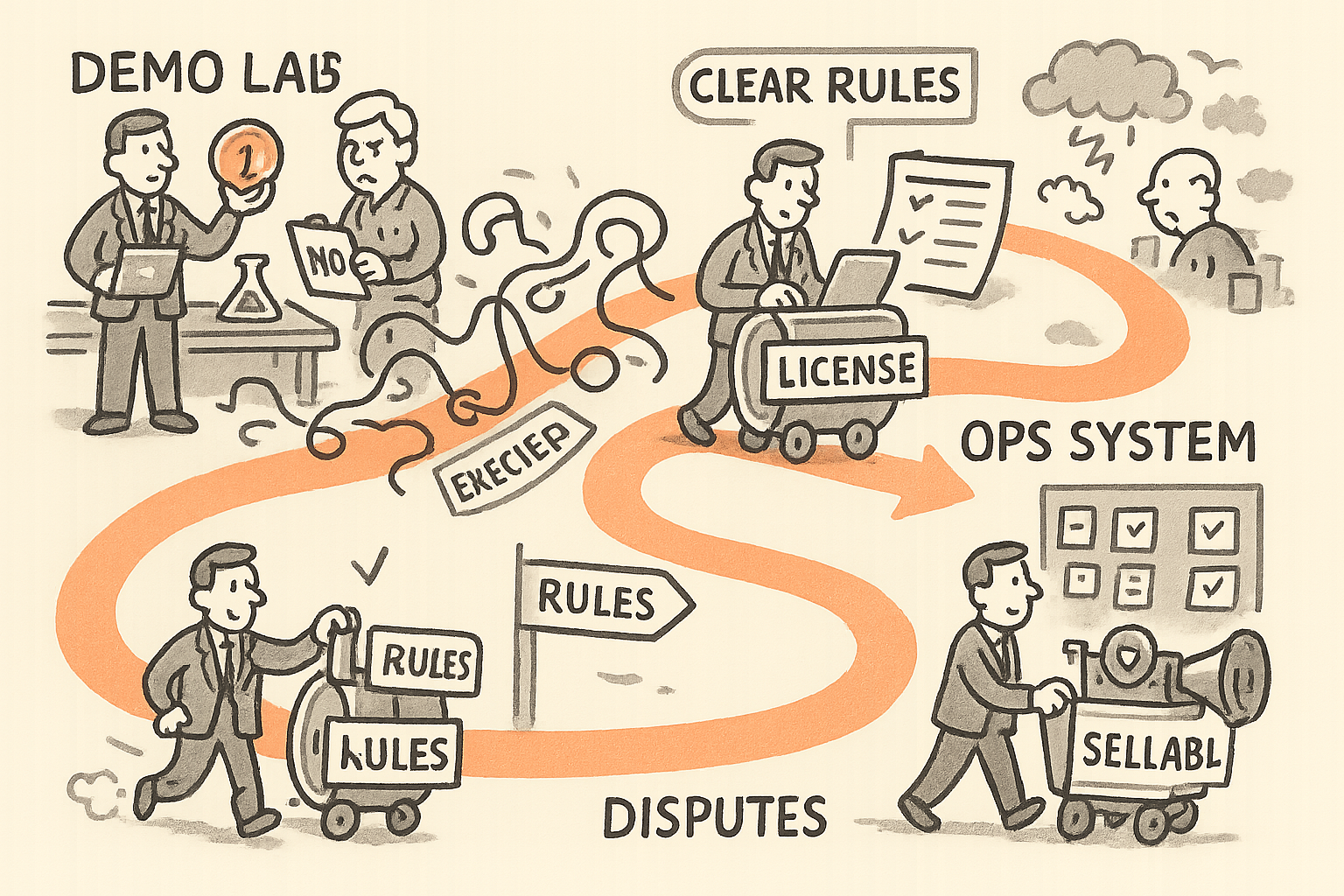
Stablecoin payments have never lacked demos. They have lacked something more boring and more valuable: a compliance shape that a CFO, an auditor, and a bank can live with for years.
When you combine a crypto-asset service permission set with an e-money style license (think: the ability to handle funds with clear safeguarding, governance, and reporting expectations), stablecoins stop being a science project. They become a payable product. You can price it. You can staff it. You can document it. You can sell it without building a new exception for every customer and every corridor.
That is the good news.
The hard news is that regulation never made a payment product win. Distribution and disputes win. The operator who nails onboarding, reconciliation, support, and failure-handling will beat the operator with the prettier rails.
I have seen this pattern in different clothes: in industrial technology where the spec sheet looked perfect until the first outage, and in SaaS where the feature existed but the workflow did not. When I ran an international business unit in smart-building and home-automation, reliability was not a slogan. It was an operating system across product, supply chain, support, and partner training. The same mindset applies to money movement. Finance teams do not buy rails. They buy outcomes and accountability.
Regulation gets you to “yes, we can.” It does not get you to “we should.”
A combined regulatory posture matters because it turns unknowns into checklists. It gives you defined responsibilities: KYC and AML controls, safeguarding rules, reporting cadence, governance expectations, and supervision. That changes two things immediately.
- Sales becomes repeatable. You can sell the same product to the next customer without renegotiating what you are allowed to do.
- Operations becomes scalable. You can build standard playbooks and hire for them, instead of relying on a few heroic compliance generalists.
But buyers are not evaluating your license. They are evaluating your risk surface. A regulated wrapper lowers perceived risk, but it does not eliminate operational risk. And operational risk is what shows up in the monthly close, the support inbox, and the board pack.
If you want stablecoin payments to move from “possible” to “preferred,” you need to answer four finance questions in plain language:
- What happens when something goes wrong?
- Who carries the loss while we investigate?
- How do we reconcile this to our ledger without manual work?
- How fast can we reach a human who can fix it?
These are not crypto questions. These are payment questions. And they are why most payment products lose, even with great technology.
Final settlement is not final responsibility
Stablecoin rails are often framed as “final.” That is true in a narrow technical sense. It is not true in a business sense.
In card payments, reversals and chargebacks are a built-in arbitration system. Merchants hate the friction, but finance teams love the predictability: there is a known process, a timeline, and a way to allocate liability. Stablecoin settlement removes some intermediaries, but it does not remove disputes. It just pushes the dispute handling up the stack, into your product and your operating model.
So you need a “chargeback analog” even if the blockchain transfer is irreversible. Not a copy of card rules, but a controlled process that gives the merchant a credible answer to:
- “The customer says they did not authorize this.”
- “The goods were not delivered.”
- “We refunded, but the customer claims they did not get it.”
- “We sent the funds, but to the wrong address or network.”
In practice, this means you end up building escrow-like holds, risk-based release, refund tooling, evidence collection, and merchant-facing SLAs. If you do not, your biggest customers will not route volume through you. Not because they do not like stablecoins, but because they cannot run their business on “final means good luck.”
This is the same logic I learned earlier in my career in power electronics. A drive can be world-class on paper, but the customer buys uptime, diagnostics, and the ability to recover from failure without drama. Payments is a reliability business, too. If you want a useful parallel, the product is not the rail. The product is the recovery path. I wrote about this reliability contract mindset in Ruggedization Isn’t a Checkbox.
Unit economics are decided in the ugly middle
Once you can operate legally, the next bottleneck is economics at scale. Most teams model fees on the happy path. Real margins are decided by the ugly middle: on-ramps, off-ramps, FX, treasury, fraud, refunds, and support.
Here is the operator lens I use. Stablecoin payments become a business when you can control three cost centers:
- Cost of money movement. Not just chain fees. The full cost across funding, cash-out, and FX spread management.
- Cost of exceptions. Every manual investigation is margin leakage. Every unclear status update creates tickets and churn.
- Cost of risk. Fraud, account takeover, sanctioned exposure, and operational errors all become P&L items the moment you offer guarantees.
Teams underestimate how fast exception volume scales. It is nonlinear. A small percentage of problematic transactions turns into a large support operation once volume grows, because the customers affected are loud and urgent, and because finance teams batch issues into month-end panic.
When I was interim CEO and co-founder of EatMore, we learned a simple truth in hospitality: adoption followed the workflow, not the feature. If order status did not match reality, if refunds were messy, if staff could not resolve issues in one minute during peak hours, the product did not matter. Payments is the same. If reconciliation and resolution are not native to the product, merchants will not trust it with serious volume.
Distribution beats rails, but only when the workflow is native
“Distribution” is not only having a sales team or partners. In payments, distribution means living inside the systems that already run the business:
- Checkout and billing flows
- ERP and accounting exports
- Refund and dispute queues
- Treasury dashboards
- Support tooling
The stablecoin product that wins will not ask merchants to change how they close the month. It will adapt to how the month is closed. That requires integration decisions that are not glamorous but are decisive.
Three integration moves I would prioritize if I were building this product tomorrow:
- Make reconciliation deterministic. Every transaction needs a stable identity that survives across authorization, settlement, refunds, partial refunds, and fee adjustments. If you cannot map it cleanly to a ledger entry, you will not scale in mid-market, and you will never reach enterprise.
- Ship finance-grade reporting, not developer logs. Finance wants summaries, variance explanations, and exportable evidence. Engineering wants traces. You need both, but the buyer renews for the finance output.
- Offer guarantees selectively. You cannot guarantee everything at the start. But you can define tiers: instant settlement with merchant risk, delayed release with your risk, or insured corridors. Clear options beat vague promises.
This is why I keep coming back to the idea of a control plane in payments. The rail matters, but the control plane decides adoption. If you want the deeper framing, my piece A Debit Network Is Not a Network. It Is the Checkout Control Plane. captures the same logic from another angle.
The operator checklist for making stablecoins “finance-team safe”
If you are a board member or operator evaluating a stablecoin payments strategy, I would pressure-test it with a checklist that forces clarity beyond the regulatory posture.
- Onboarding: Can we complete KYC and KYB without stalling deals, and do we have a path for edge cases (complex ownership, cross-border entities)?
- Safeguarding and segregation: Is the customer money story simple enough to explain to an auditor in one page?
- Reconciliation: Can the merchant reconcile daily automatically, and can we explain every discrepancy with evidence?
- Disputes: What is our process, timeline, and liability model for unauthorized payments, non-delivery claims, and refund conflicts?
- Refunds: Can a merchant issue a refund in seconds, including partial refunds, and can they prove it happened?
- FX and treasury: Who manages exposure, where are limits set, and what happens when liquidity is tight?
- Support: Is there a staffed escalation path with real authority, not a chatbot and an email queue?
- Risk controls: Do we have configurable holds, velocity limits, sanctions screening, and anomaly detection that can be tuned per merchant segment?
- Commercial packaging: Is pricing aligned with the value the merchant perceives (speed, cost, acceptance), and does it still work after you include exception handling?
If you cannot answer these crisply, the license may get you in the room, but it will not keep you there.
My take: MiCA plus EMI is the starting line. The product is operations.
I like regulatory clarity because it turns opinions into requirements. That is how you scale responsibly. But I have never seen compliance alone create a durable advantage.
In my own ventures, including Shopeno and IBHQ, the lesson has been consistent: you win when the workflow becomes obvious and the failure modes are handled like a first-class product. Stablecoin payments will follow the same path. The winners will not be the teams that talk most about rails. They will be the teams that treat disputes, reconciliation, and guarantees as the core product, then distribute that product inside the tools finance teams already use.
That is how stablecoins turn from “payable” into “preferred.”
Newsletter
Working notes, straight to your inbox.
Occasional, no-noise notes on leadership, execution, and applied AI — from the field, not the sidelines.