4 August 2026 · 8 min read
How to Turn EU AI Funding Into Shipped Capabilities (and Avoid Grant Theater)
Money is not the bottleneck. Governance, co-funding discipline, and procurement speed are.
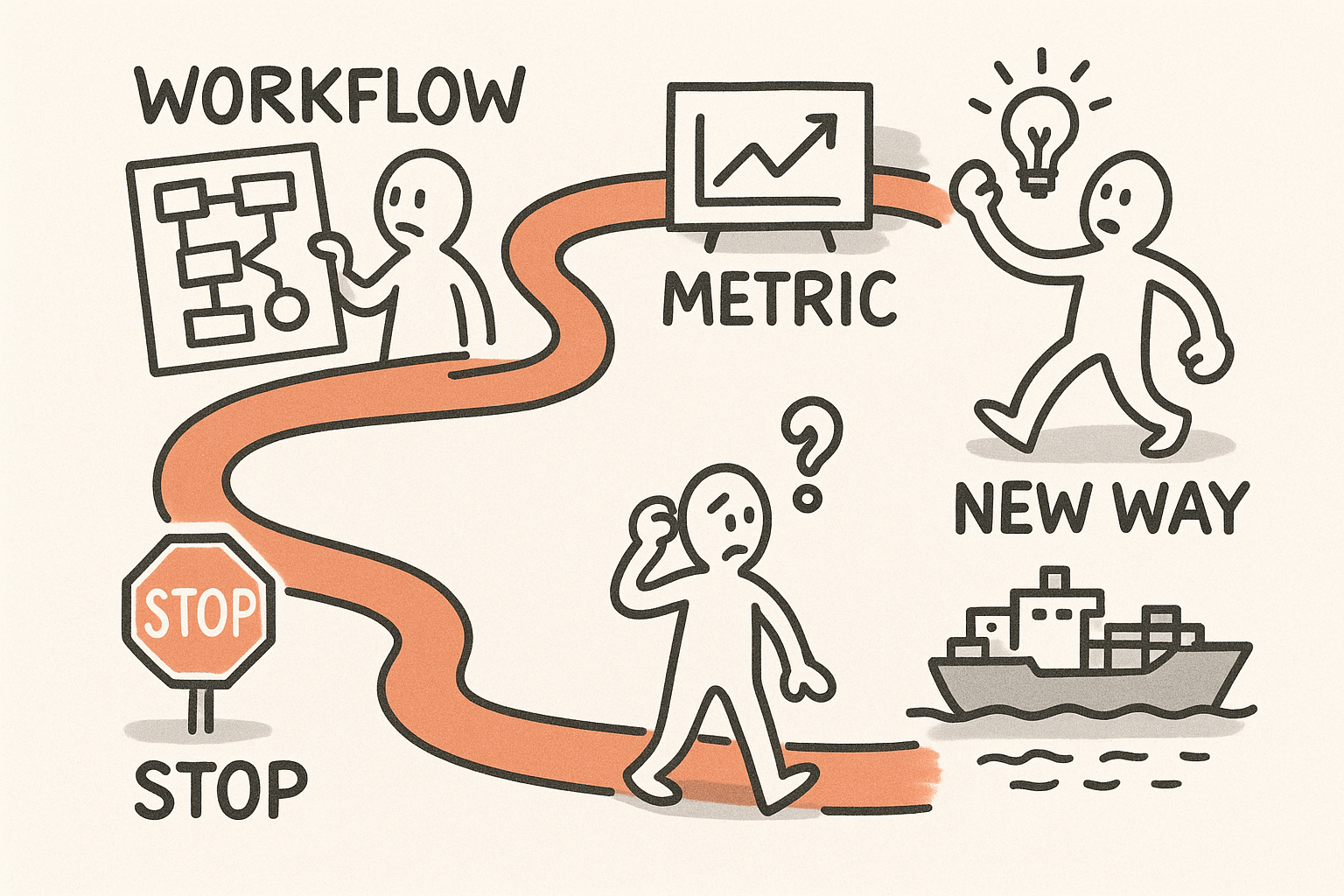
There is a specific kind of disappointment you only feel after months of workshops, slide decks, and stakeholder alignment: the moment you realize you are “AI-active” but still not measurably better at the work that pays your bills.
EU funding makes that disappointment more likely, not less. Not because the money is bad, but because the incentives are. Grants reward narratives, consortia, and novelty. Businesses win by shipping capability into real workflows, then repeating until it compounds.
Denmark is being told it has a good shot at capturing EU AI billions, but that it will “require something” from companies and the ecosystem (as described in Computerworld’s coverage). Here is what that “something” looks like if you want outcomes, not theater.
This is a playbook for turning co-funded AI initiatives into shipped capabilities: governance that can decide, co-funding mechanics that do not poison priorities, procurement that does not stall delivery, and a hard tie between funding and measurable workflow P&L impact.
Start with the only unit that matters: the workflow
If you begin with a model, you will end with a demo. If you begin with “an AI strategy,” you will end with a steering committee.
Start with one workflow that already has a budget owner and a pain you can price.
- Define the workflow boundary. Not “customer service,” but “handling inbound cases of type X from receipt to resolution, including handoffs.”
- Name a single accountable person. The person who can trade off cost, risk, and speed. If accountability is shared, delivery becomes optional.
- Pick one measurable outcome. Cycle time, rework rate, conversion, churn, cost per case, claim leakage, engineer hours per release, whatever maps to your economics.
- Write the “before” truth. Baseline the metric with current data. If you cannot measure the baseline, you are not ready to promise improvement.
This is also where most AI programmes quietly fail: they treat the workflow as a backdrop, not as the product. I have made this point elsewhere, because it keeps repeating in different costumes, and it is still true: AI leadership is workflow leadership.
Governance that ships: three decisions, every two weeks
Grant-funded work tends to create ceremonial governance. Lots of “alignment,” little decision-making. If you want delivery, governance must be small, frequent, and directly connected to the workflow metric.
Run a two-week cadence where the group makes only three decisions:
- What ships next? A capability that changes the workflow, not an experiment that produces a report.
- What do we stop? Any workstream that does not move the metric, reduce a known risk, or unblock deployment.
- What do we learn in production? A specific hypothesis to validate with live usage, plus how you will capture it.
Everything else is a status update. If your steering group cannot stop work, it is not governance. It is spectator seating.
Two rules keep this honest:
- One-page decision memos. If the argument cannot fit on a page, you do not understand the trade-offs yet.
- Pre-commit the kill switch. Define the threshold at which you pause or roll back. Not because AI is scary, but because production systems deserve discipline.
If this sounds heavy, it is lighter than the alternative: shipping late, then discovering that the “value case” lived only in the application.
Co-funding mechanics: keep the incentives clean
Co-funding is useful when it pulls forward investment you would have made anyway, but later. It becomes toxic when it makes you build something you would not buy with your own money.
Use three mechanics to keep incentives aligned:
1) Treat the grant as a constraint, not a roadmap
The grant defines reporting obligations and eligible cost categories. It should not define what you build. Your roadmap stays anchored in workflow outcomes and product reality, then you map activities to eligibility.
If you reverse this, you will optimize for reimbursable effort. That is the definition of grant theater.
2) Require real co-funding from the budget owner
If the workflow owner has no skin in the game, you will get polite support and zero adoption. Set a rule: the business unit pays a meaningful portion from its own budget, even if the grant could cover more.
This does two things:
- It forces prioritization against other spend.
- It makes adoption someone’s job, not everyone’s hope.
3) Fund outcomes in tranches, not activities in bulk
Even if the EU programme is activity-based, you can run your internal approval as outcome-based. Release internal budget in tranches tied to shipped milestones that affect the workflow.
Example tranche gates:
- Gate A: baseline measured, data access contract signed, risk assessment complete.
- Gate B: first production deployment to a limited group, monitoring and rollback tested.
- Gate C: workflow metric moved by X% for Y weeks, with documented change management.
This is the same principle behind avoiding predictable budget explosions. Overspends are often not surprises. They are the result of letting spending continue without decision gates. I wrote a separate piece on that governance pattern here: Budget overruns are rarely a surprise. They are a governance choice.
Procurement speed: buy time, not paperwork
EU-funded initiatives collide with procurement in two ugly ways: slow purchasing cycles, and vendor choices driven by compliance comfort rather than delivery fit.
You do not fix this by “going around procurement.” You fix it by designing a procurement path that matches software delivery reality.
Here is what has worked consistently across different kinds of organisations:
- Pre-approve a vendor bench. Do the due diligence once, then let teams draw from a short list quickly.
- Standardize the contract skeleton. Security, data processing, IP, and liability clauses should not be reinvented for every purchase.
- Buy small, renew often. Start with 8 to 12 weeks of work and explicit deliverables, then extend based on shipped outcomes.
- Procure integration, not “AI.” Most value is in plumbing: identity, access, data pipelines, monitoring, and human handoffs.
When procurement is slow, teams compensate by over-scoping. They ask for a giant contract because they fear they will not get a second chance. That is how you turn a practical workflow improvement into a multi-year programme.
One more caution: buying more of the stack increases the number of ways you can fail. It is not a moral statement. It is a reliability statement. If you want that argument in full, it is here: Owning more of the stack is just owning more failure modes.
How to measure “workflow P&L impact” without lying to yourself
Grant applications love big numbers. Businesses suffer when those numbers become self-deception.
Define impact in a way your finance team can respect, and your delivery teams can influence.
Use a two-layer scorecard
- Workflow metric (leading). The operational measure you can move weekly (cycle time, first-contact resolution, quote accuracy, defect escape rate, etc.).
- Economic metric (lagging). The financial measure that follows (gross margin, cost per unit, churn, working capital, revenue per rep, etc.).
The trap is claiming direct euro impact from a metric that is only loosely connected to money. Avoid that by writing the causal link explicitly, then testing it in production.
Run a “counterfactual” check every month
Ask one uncomfortable question: “If we had not built this, what would have happened?” Use control groups when you can. When you cannot, at least compare cohorts (teams, regions, product lines) and document confounders.
This is not academic purity. It is protection against your own enthusiasm.
Make adoption measurable, not assumed
Many AI teams report “released” when they mean “merged to main” or “available in a tool.” For workflow impact, adoption is usage in the actual handoff points.
Track:
- Percent of cases touched by the capability.
- Time saved that is actually taken out (not reallocated in theory).
- Error rate before and after, including rework created upstream or downstream.
The real KPI is boring: how often did the work happen the new way, and did the business keep the benefit?
One lived lesson: grants magnify the cost of unclear responsibility
I once watched an ERP cutover eat a year because decision rights were fuzzy. The technology was not the hard part. The hard part was that nobody could say “yes” fast enough, and nobody could say “stop” loudly enough.
EU-funded AI can replay the same failure mode, just with better branding. Reporting calendars replace shipping calendars. Stakeholder inclusion replaces accountability. The result is a portfolio of pilots that cannot be supported, audited, or expanded.
The antidote is simple and strict: tie each funded initiative to one workflow owner, one metric baseline, one deployment path, and one kill switch. Then ship in increments that users feel.
The playbook, condensed
- Pick one workflow with a budget owner. If it has no owner, it has no future.
- Baseline one metric. If you cannot measure “before,” you cannot prove “after.”
- Design governance around three decisions every two weeks. Ship, stop, learn.
- Demand real co-funding from the business. Adoption follows accountability.
- Procure for speed and integration. Pre-approved bench, small contracts, standard clauses.
- Measure impact with a two-layer scorecard. Leading workflow metric plus lagging economics.
- Scale only what survives production. If it cannot be monitored, rolled back, and supported, it is not a capability.
My opinion is blunt: EU AI money is most valuable when it forces you to become more disciplined than you would have been with your own cash. If the funding makes you less disciplined, you will pay for it twice, once in time and once in cynicism.
Use the grants to buy learning speed, to harden your data and deployment habits, and to ship workflow improvements that a finance team can defend. Anything else is paperwork disguised as progress.
Newsletter
Working notes, straight to your inbox.
Occasional, no-noise notes on leadership, execution, and applied AI — from the field, not the sidelines.