28 July 2026 · 7 min read
Budget overruns are rarely a surprise. They are a governance choice.
If cost truth arrives late, the overrun is already contracted. The fix is not better reporting. It is interface ownership, supplier strategy, and stage gates that force evidence early.
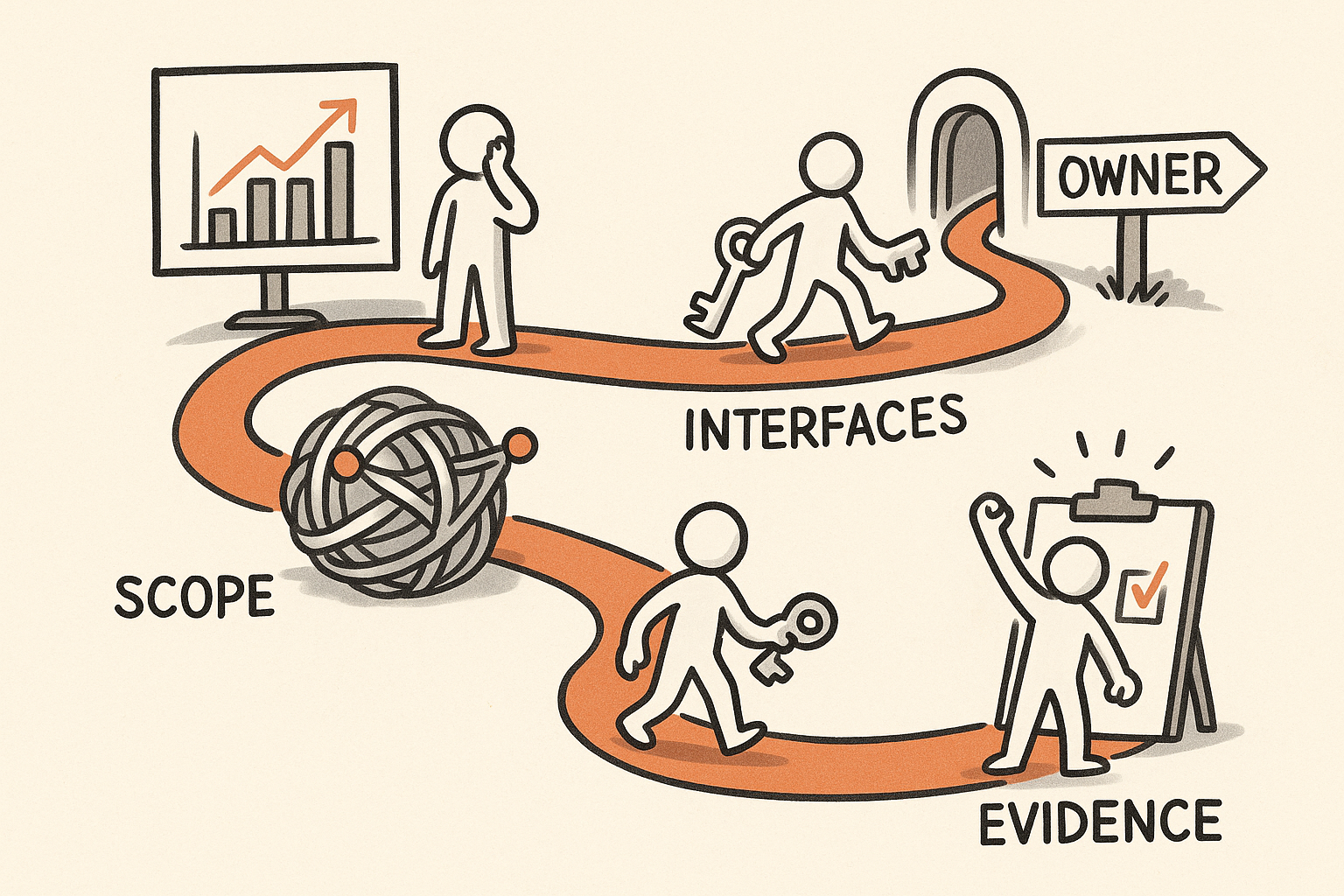
I have never seen a serious overrun arrive like lightning. It arrives like rust. Slowly. Quietly. Then all at once you discover the number was locked in months ago.
The criticism around Bornholm Energy Island, as described in ing.dk’s coverage of the budget problems and accountability debate, reads like a pattern I have watched across industrial programs: cost truth is delayed, interfaces stay fuzzy, contracts get signed under timeline pressure, and later everyone can honestly say, “I was not informed.”
That is why I believe budget overruns are rarely a surprise. They are a governance choice. Not a malicious choice. A structural one. The moment you allow “we’ll clarify later” to sit inside scope, interfaces, or change control, you are choosing a future where the financial truth comes too late to act on it.
When I ran operations in electrification and energy storage as a former COO, the engineering risks were rarely the first failure. The first failure was letting delivery dependencies sit between organizations without a single owner. The work still moved forward, but the accountability for time and cost did not.
The overrun is usually contracted before it is reported
Leaders often talk about “visibility” as if the problem is dashboards. But the mechanics of overruns are more physical than that.
- Interfaces get defined late. Late interface definitions force redesign, rework, and expedited procurement. That cost is real, even if it is not yet booked.
- Supplier strategies get picked by politics or habit. You end up with either a prime supplier who is not truly accountable, or a modular ecosystem with nobody owning integration.
- Contracts become irreversible commitments. Once milestones, penalties, and long-lead items are in motion, you can argue about numbers, but you cannot un-sign the commitment without paying for it.
- Change becomes “absorbed” until it cannot be. Teams try to be helpful. They keep momentum. They quietly accept scope creep. Later it shows up as a big number and a “surprise.”
This is why late discovery is not discovery. It is announcement. The decision already happened, just not explicitly.
The kill-chain: four governance moves that prevent expensive ambiguity
Here is the operator lesson I keep coming back to. It is not sexy, but it works. If you want fewer overruns this quarter, treat it like a kill-chain and break it early.
1) Freeze scope early, but freeze it the right way
“Freeze scope” does not mean no change. It means you define what is allowed to move and how it moves.
- Baseline scope at system level (what outcomes must exist) and at interface level (what must connect to what, and under which constraints).
- Put a price tag on every change request at the moment it is proposed, not when it is implemented.
- Define the change authority: who can approve changes under a threshold, and who must approve changes above it.
When I ran a smart-building business unit as a former CEO, with connected sensors and building controls sold across multiple countries, scope drift rarely came from “bad product management.” It came from commercial urgency meeting integration reality. Sales wanted one more variant. Service wanted one more workaround. Engineering wanted one more improvement. Without a tight change authority, every good intention becomes an unpriced liability.
2) Pick a supplier strategy that matches the real integration risk
There are only two honest strategies in complex industrial programs. Everything else is a hybrid that tries to avoid accountability.
- Single throat to choke: one prime supplier is accountable for end-to-end delivery, including integration. You pay for it. You also get a place to put risk.
- Modular multi-supplier: multiple suppliers deliver modules, but you explicitly assign integration accountability and fund it like a first-class workstream.
Modular can be faster and more competitive. It can also be a trap if you pretend integration is “project management overhead.” Integration is engineering plus operations plus contractual design. If you do not pay for it up front, you pay for it later with interest.
If you want a deeper angle on supplier dynamics, I wrote The Fastest Way to Lose Quality Is to Treat Suppliers Like a Contract Problem. The short version is this: contracts allocate blame, but operating mechanisms create outcomes.
3) Assign one owner per interface, and make that ownership measurable
Most large programs fail at the seams. Not in the components.
So I run a simple rule: one interface, one owner, one acceptance test. No committees. No shared ownership. If two people own an interface, nobody owns it when it turns painful.
- Owner: a named person who is responsible for definition, alignment, and acceptance.
- Definition: a living interface spec that includes performance constraints, failure modes, and operational responsibilities.
- Acceptance test: an evidence-based gate that proves the interface works under realistic conditions.
This is as true in industrial electrification as it is in SaaS. When I build products in my own ventures like Shopeno and IBHQ, “interfaces” show up as API contracts, data ownership, and operational handoffs. The form changes. The governance principle does not.
4) Run hard stage gates where funding follows evidence, not announcements
Stage gates are not bureaucracy. They are the only scalable way I know to stop optimism from becoming financial policy.
My preference is to make gates binary and evidence-driven:
- Gate 0: Scope and interfaces are baselined. If you cannot define the seams, you cannot price the system.
- Gate 1: Supplier strategy is chosen and integration accountability is explicit. Prime or modular, but with a real owner and budget for integration.
- Gate 2: Critical risks have a mitigation plan that is funded. Not “we will look at it.” A plan with owners and dates.
- Gate 3: Evidence exists. Tests passed, prototypes validated, or operational simulations completed. Funding is released based on proof, not narrative.
This is also where “political timelines” do damage. When timelines become non-negotiable, the organization quietly trades certainty for speed. If you accept that trade, you need even harder gates, not softer ones.
The first real failure is letting “we’ll clarify later” into the plan
I learned this earlier in my career, during eleven years in power electronics and industrial automation. The systems were real. They ran in water and wastewater plants, HVAC environments, and automation lines. Failure modes were tangible.
But the earliest failures still looked managerial, not technical. A late clarification on requirements. A missing decision on who owns commissioning. A supplier assumed someone else would validate an edge case. Each one felt small. Together, they became cost and schedule reality.
In programs involving public and private actors, ambiguity becomes even more dangerous because accountability fragments naturally. People operate in good faith inside their slice. Nobody owns the whole number.
When the number is owned by everyone, it is owned by no one.
If you want a practical companion to this idea in organizational terms, CEO-led transformation, the operator way: five mechanisms that prevent silo theater covers the internal mechanics that stop handoffs from becoming alibis.
A checklist you can apply this quarter
If you are running a complex program right now, here is what I would do in the next 30 days. No reorg required.
- Publish the interface register. List every major interface (technical, commercial, operational). Put a single name next to each one. If you cannot name the owner, you have found a future overrun.
- Baseline scope with “allowed change” rules. Define what types of change are allowed without escalation, and what must go to a formal change authority.
- Choose your supplier strategy explicitly. Prime supplier with real integration accountability, or modular with a funded integration workstream. Do not pretend you can get both benefits without paying for one of them.
- Turn your next stage gate into an evidence gate. Pick three proof points that must be true before the next funding release. Tests, prototypes, commissioning readiness, or validated costed BOM. Evidence beats narrative.
- Install cost truth cadence. One weekly forum where the current estimate at completion is discussed with owners present. Not to blame. To force early reality.
This is governance as an operating system. It is not about being strict. It is about being explicit early, so you do not become “surprised” later.
My opinion: predictability is purchased up front
People often say, “We need to be agile.” Fine. But agility without accountability is just improvisation paid for by someone else.
When I look at large programs like the one discussed in the Bornholm Energy Island criticism, I do not see a story about one person failing. I see a story about governance allowing cost truth to arrive after contractual truth.
Budget overruns are rarely a surprise. They are what happens when we let interfaces float, let scope drift without pricing it, and let funding follow announcements instead of evidence. The fix is not more reporting. The fix is choosing, early, who owns what, how change is priced, and when proof is required.
Newsletter
Working notes, straight to your inbox.
Occasional, no-noise notes on leadership, execution, and applied AI — from the field, not the sidelines.