10 July 2026 · 8 min read
AI Leadership Is Workflow Leadership: Own the Handoffs
Treat AI like industrial automation. The teams that win do not “adopt models”. They design and own the end to end loop.
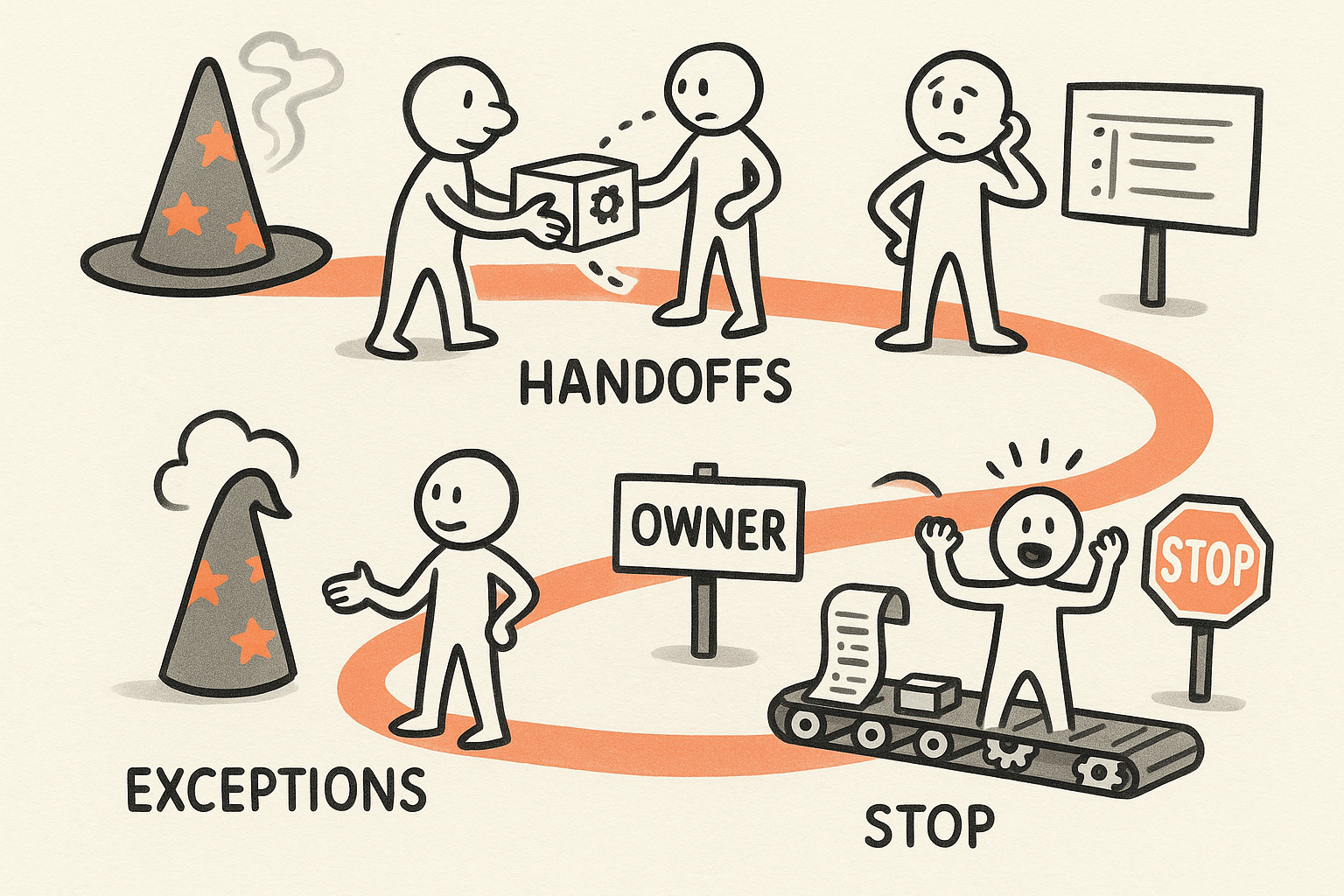
I have watched the same pattern repeat across factories, connected devices, SaaS, and fintech: the technology is rarely the bottleneck. The handoffs are.
AI makes that painfully obvious. A model can be impressive and still produce zero business value if the workflow around it is unclear. Who supplies the inputs. Who approves the output. What happens on exceptions. Who is accountable when it fails. If those answers are fuzzy, the “AI project” becomes a permanent pilot.
When I ran R&D organizations across embedded software, cloud, electronics, mechanics, and QA, I learned a simple rule: output follows ownership. Not motivation. Not talent density. Ownership. And ownership in the AI era is mostly about workflows, especially the messy parts between teams.
This is my core belief: AI leadership is workflow leadership. The winning teams own the handoffs.
The misconception: AI is a tool you sprinkle on top
Most leaders try to “add AI” the way they add a dashboard. They pick a use case, fund a model, and wait for magic. Then reality hits:
- The data arrives late, partial, or inconsistent.
- The business cannot agree on what “good” looks like.
- Legal or compliance gets pulled in at the end.
- Operations discovers the model fails exactly where the process is already fragile.
- Everyone blames the model.
In industrial automation, nobody would accept that. You would never deploy a robot arm without specifying the feeder, the sensors, the safety interlocks, the reject bin, the maintenance plan, and the operator instructions. AI deserves the same seriousness.
The uncomfortable part is that this is not primarily a technology problem. It is an operating model problem. “Who owns the workflow” is the question that decides whether AI becomes leverage or noise.
Where AI value actually comes from: the closed loop
Every AI system that creates measurable value has the same shape. It is a closed loop with explicit ownership at each step.
- Input contract: what comes in, from where, in what format, with what quality checks.
- Decision point: what the AI is allowed to decide, recommend, or draft.
- Approval and escalation: who signs off, when it can auto execute, and when it must stop.
- Exception handling: how edge cases are routed, categorized, and resolved.
- Feedback: how outcomes are captured so the system improves, or at least does not repeat mistakes.
If you are missing any of these, you do not have an AI product. You have a feature with a risk profile you do not understand.
This is also why cross functional teams win. Not because it is fashionable, but because the workflow crosses boundaries by definition: sales to ops, ops to finance, support to engineering, compliance to product. If the handoffs are unmanaged, your AI system will inherit the worst of your org chart.
The handoffs are the product
When I was CEO of a smart-building and home-automation business unit, the most painful failures were rarely in the sensor or the cloud. They were in the gaps: between product and manufacturing, between manufacturing and suppliers, between support and R&D. Connected systems make handoffs visible because everything is traceable, including delays, rework, and blame.
AI does the same, but faster. It amplifies whatever you already are:
- If your inputs are disciplined, AI compounds that discipline.
- If your approvals are political, AI becomes a new battleground.
- If your exception handling is ad hoc, AI will generate a flood of “special cases” and your team will drown.
So I treat the handoffs as part of the product design. Not as “change management”. Not as “training”. As design.
That mindset also shows up in my own ventures. When building products like Shopeno and IBHQ, the goal is not to impress with AI. The goal is to remove friction from a complete workflow: onboarding, verification, daily operations, support, and control. That forces a different kind of leadership. You cannot hide behind a model if the workflow breaks for a real user at 7:30 on a Monday.
A practical operating model: one owner, one lane, one stop button
If you want measurable output gains, I suggest a blunt operating model. It is not the only one, but it is the one I have seen survive contact with reality.
1) Name a workflow owner, not an “AI lead”
Pick one workflow that matters (cash collection, customer support triage, supplier NCR handling, warranty claims, backlog grooming). Assign a single accountable owner for the end to end outcome.
This person must be able to coordinate across functions. If they cannot influence inputs and approvals, they will fail and you will blame the wrong thing.
2) Define the lane: recommend, draft, or execute
Most AI rollouts fail because the lane is ambiguous. Make it explicit:
- Recommend: AI suggests, a human decides. Good for first deployment.
- Draft: AI prepares the work product (email, report, code, claim summary), a human approves.
- Execute: AI acts automatically within strict boundaries and controls.
If you cannot clearly say which lane you are in, you will oscillate between over trust and over control. Both kill adoption.
3) Design the exception path before you ship
Exceptions are not edge cases. They are the real workload. The fastest way to burn credibility is to deploy AI that works “most of the time” and then forces your best people to mop up failures manually.
Define three buckets:
- Known exceptions (already understood): route with rules.
- Unknown exceptions (new patterns): route to humans with a capture form.
- Prohibited actions: hard stops. No debate. No “just this once”.
This is also where you decide how fast you want to learn. If unknown exceptions are not categorized and fed back, you are paying tuition without getting smarter.
4) Put a stop button in the workflow, not in a policy document
In plants and production lines, safety is designed into the system. It is not a slide deck. AI needs the same thinking. You need a practical stop mechanism that the operator can use without asking permission.
The stop button can be as simple as a toggle, a confidence threshold that forces human review, or an approval gate when certain conditions are met. What matters is that it is real, immediate, and owned.
If you want a deeper operator lens on this, the idea connects directly to AI value isn’t in the org chart. It’s in the stop button.
5) Measure throughput and rework, not “hours saved”
Hours saved is a vanity metric because it ignores quality and downstream costs. In manufacturing, nobody celebrates a faster line if defects double. The same is true for AI in knowledge work.
Track:
- Cycle time from input to approved output.
- First pass yield (how often the AI output is accepted without rework).
- Escalation rate and top causes of exceptions.
- Downstream defect rate (refunds, reopens, compliance flags, customer complaints).
This aligns with the argument in Stop Measuring AI by Hours Saved. The point is not to work less. The point is to deliver more correct outcomes per unit of effort.
A lived example: what I did differently after years in industrial quality
I spent eleven years in power electronics and market quality. That environment trains you to respect failure modes. A drive can work perfectly in a lab and still fail in the field because of installation variance, environmental conditions, supplier tolerances, or human error. The fix is rarely a heroic engineering effort. It is usually a tighter system: clearer specs, better test coverage, stronger feedback loops, and unambiguous ownership for corrective actions.
Later, when I led R&D and then ran a business unit building connected sensors and building controls, I carried that same discipline into software and data work. When something broke, the question was not “who coded this”. It was “where did the workflow allow ambiguity”. Input definitions. Ownership boundaries. Approval criteria. Support handoff. Release gates.
AI projects need that exact posture. If you treat AI as automation, you automatically ask the right questions: what are the tolerances, what is the reject flow, who gets paged, what is the containment plan, what is the CAPA equivalent for a bad decision.
That is why I keep coming back to workflow leadership. It is the only form of AI leadership that scales.
The decision lens I use now
When a team proposes an AI initiative, I run five questions. If we cannot answer them crisply, we are not ready to ship.
- What is the unit of output we are trying to increase (claims closed, quotes sent, tickets resolved, invoices matched, orders processed).
- Who owns the end to end workflow, including the ugly parts.
- What is the lane (recommend, draft, execute), and what are the hard stops.
- Where do exceptions go, and how do they become learning.
- What metric will punish us for rework, not reward us for speed alone.
If you want a more technical complement to this operating lens, it pairs well with AI Architecture Isn’t a Diagram. It’s an Operator’s Checklist.
My opinion: the winners will look “unromantic”
The teams that win with AI will not be the ones with the most exciting demos. They will be the ones with the most boring reliability. Clear inputs. Explicit approvals. Designed exception handling. Real stop mechanisms. And a single owner who is accountable for throughput and quality.
That is workflow leadership. And it is the leadership style the AI era is selecting for.
Models will get cheaper and more capable. Your handoffs will not fix themselves.
Own the workflow. Own the handoffs. Then AI becomes a compounding advantage instead of another line item in the innovation budget.
Newsletter
Working notes, straight to your inbox.
Occasional, no-noise notes on leadership, execution, and applied AI — from the field, not the sidelines.