22 July 2026 · 7 min read
CEO-led transformation: five mechanisms that prevent silo theater
If you want AI and tech change to stick, run it like a plant upgrade: clear decision rights, a KPI spine, and stage gates tied to yield.
I have lived through enough “transformations” to distrust the word.
When I ran an international business unit in smart building controls, I watched how quickly a good ambition turns into silo theater. One function announces an AI initiative. Another buys tools. A third writes governance decks. Six months later, nothing is faster, cheaper, or more reliable. People are tired, and the organization has learned the wrong lesson: “We tried. It did not work.”
The problem is rarely the tech. It is the operating system around it. As McKinsey puts it, transformations often falter due to internal dynamics that divide organizations, such as misaligned incentives, siloed efforts, and risk aversion. That is a collective-action problem, not a model-accuracy problem.
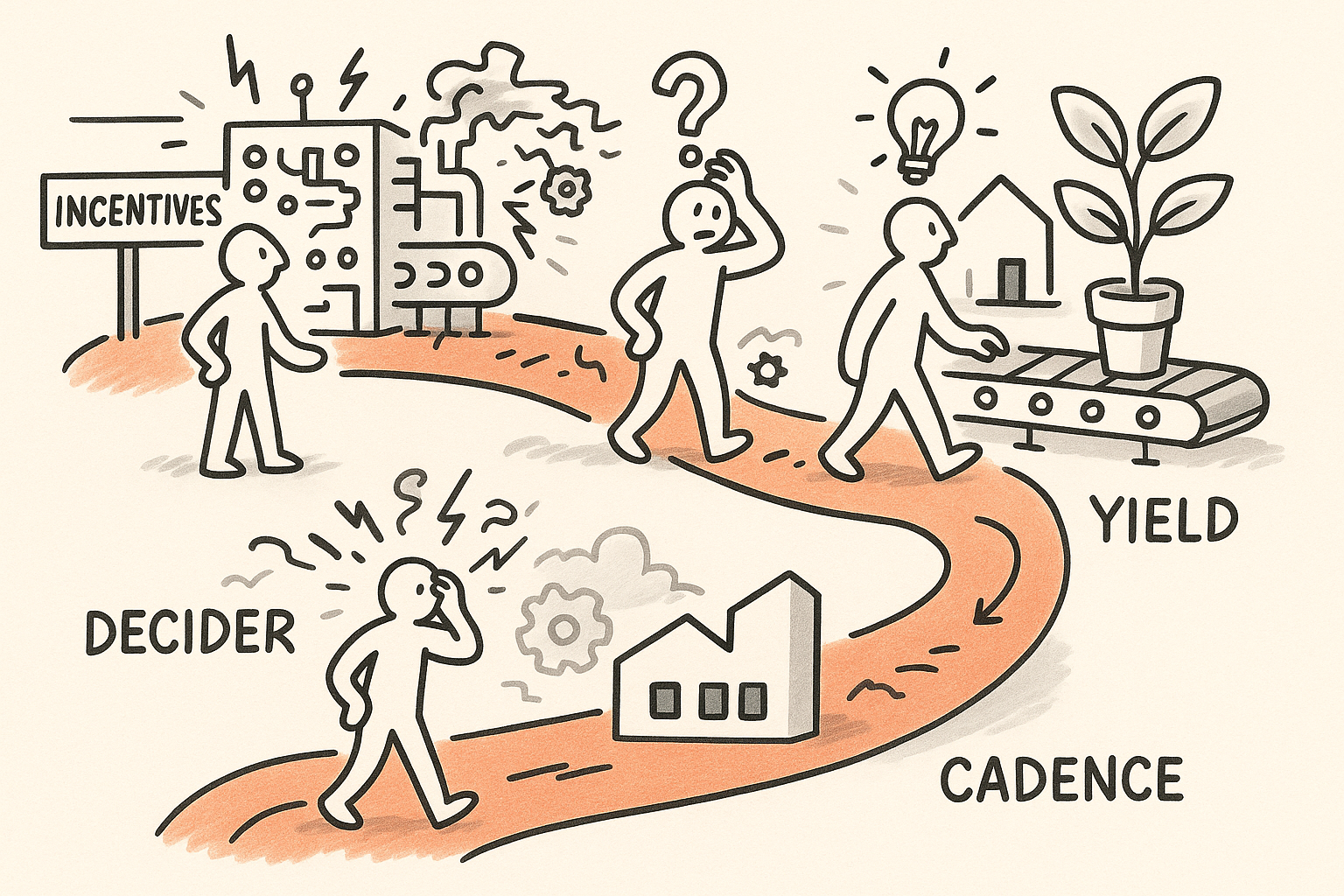
So here is my operator version of “CEO-led transformation”. Not a speech. Not a poster. Five non-negotiable mechanisms that force alignment: incentives, decision rights, cadence, a KPI spine, and talent moves. Instrument them like a plant upgrade. Use stage gates. Demand yield.
1) Incentives: pay for enterprise outcomes, not local activity
If you want cross-functional change, stop paying people to optimize inside their silo.
In manufacturing and industrial tech, everyone understands yield. You do not reward a cell for running fast if scrap doubles downstream. Yet in many tech transformations, we reward activity: number of automations, number of dashboards, number of “use cases”. Activity is cheap. Outcomes are hard.
My rule: every transformation KPI must have a “shared owner” and a “shared check”. Shared owner means at least two functions are jointly accountable. Shared check means the metric cannot be improved by one function without the other signing off that customer impact stayed whole.
Bad incentive: “Deploy copilots to 500 employees.” It can be gamed with licenses and training attendance.
Good incentive: “Reduce quote-to-order lead time by X and error rate by Y.” It forces sales, ops, and IT to redesign the handoffs.
If you need a simple mechanism, use a 70 20 10 split on variable compensation for transformation leaders: 70 percent enterprise KPI spine, 20 percent function health, 10 percent experimentation. The point is not the exact ratio. The point is the hierarchy.
2) Decision rights: name the decider, then lock the interface
Transformations stall when nobody can say “no”, and nobody can say “we ship”.
As a former Head of R&D rebuilding a 22-person cross-discipline team (embedded, cloud, electronics, mechanics, QA), I learned that clarity beats consensus. You can have great people and still lose months to ambiguous authority.
Define decision rights at two levels:
Business decisions: which workflows change, what risk is acceptable, what the customer promise is.
Technical decisions: what architecture, what data contract, what integration pattern.
Then enforce a rule that feels almost rude: each decision has one decider. Not a committee. Not “jointly”. One decider, with named input roles.
The second part is the part most CEOs miss: lock the interface. You cannot scale AI if every team defines “order”, “customer”, “fault”, or “margin” differently. Your “data contract” is the interface. If it changes without governance, your plant runs out of spec.
If this is your current pain, I have written a deeper operator take on ownership and interfaces in AI Leadership Is Workflow Leadership: Own the Handoffs.
3) Cadence: transformation is a production system, not a project plan
Most transformations have one of two cadences:
Monthly steering meetings where status is green until it is suddenly red.
Daily chaos where everyone is “agile” but nothing lands in production.
Run it like operations. Stable cadence. Short feedback loops. Visible constraints.
I use three layers:
Weekly execution review (60 minutes): stage gate status, blockers, scope control, next releases. Only people who unblock or ship.
Biweekly business review (60 to 90 minutes): KPI spine trend, customer impact, risk decisions. This is where tradeoffs get made.
Quarterly reset (half day): stop list, top five bets, capacity allocation, and what gets killed.
The CEO value is not attendance. It is the discipline that no one else can enforce: tradeoffs across functions, and a kill decision that protects focus.
4) KPI spine: one line of truth from workload to cash
A KPI spine is not a dashboard. It is the minimum set of metrics that connects operational reality to financial reality, without interpretation gymnastics.
In industrial environments, the spine is familiar: throughput, yield, downtime, cost per unit, on-time delivery. In AI and tech transformations, people often jump straight to model metrics. That is a trap. Model metrics matter, but they do not tell you if the system earns its place.
Build your KPI spine in four stacked layers:
Demand: volume of work entering the workflow (tickets, claims, orders, leads).
Flow: cycle time and queue time at each handoff.
Quality: error rate, rework rate, escalation rate, customer-visible defects.
Economics: cost per transaction, margin leakage, working capital impact, revenue conversion.
Then attach every AI or automation initiative to a specific segment of the spine. If it cannot be attached, it is a lab project. Treat it as such.
This is also why I dislike “hours saved” as a north star. Hours are not cash and not capacity unless you remove work or redeploy people deliberately. If you want that argument in full, see Stop Measuring AI by Hours Saved.
5) Talent moves: put your best operators where the pain is, not where it is comfortable
Transformations fail quietly because leaders protect their best people. They keep them close to the legacy cash engine. They staff the transformation with “available” people. Then they wonder why speed and quality disappoint.
Do the opposite. Staff the transformation like a critical plant upgrade. Your strongest line supervisors do not stay on the old line when you install a new one.
Three practical moves:
Appoint one accountable operator for each end-to-end workflow. Not an architect. Not a PM. An operator who owns throughput, quality, and economics.
Rotate high-trust talent from core ops into the transformation for 6 to 12 months, then back. That is how new operating standards spread.
Make one visible exit from a leadership role that is blocking the change. Not as punishment, as signal. If risk aversion is culturally rewarded, nothing else matters.
When I was Interim CEO and co-founder of EatMore, the inflection point was not a feature. It was when we aligned product, commercial, and delivery around one weekly commitment rhythm and held ourselves to it. A small team can hide misalignment for a while. A scaling team cannot.
Instrument it like a plant upgrade: stage gates and yield targets
Here is the part I wish more CEOs would copy from industrial execution: stage gates with explicit yield targets.
Every workflow transformation should pass five gates. No exceptions.
Gate 0, Charter: define the workflow, the customer promise, and the KPI spine segment it must improve. Name the decider. Freeze scope for 30 days.
Gate 1, Data contract: agree on definitions, sources, and ownership. If you cannot define “done” in data terms, you cannot automate safely.
Gate 2, Control plane: monitoring, error handling, rollback, and access control. This is where most AI programs cut corners and later pay interest.
Gate 3, Pilot with yield: run in parallel with humans. Set a yield target (for example, percent of cases handled end-to-end without rework). Do not “launch” without yield.
Gate 4, Scale: only scale after you prove stable operations for multiple cycles and you have a training and support loop.
Notice what is missing: “model selection”. Use the model that fits your control plane and your risk tolerance. The operator work is in the gates.
If you want a related mental model, my piece AI Architecture Isn’t a Diagram. It’s an Operator’s Checklist. goes deeper on the control mechanisms that keep systems replaceable.
My closing opinion: CEO-led transformation is not leadership theater, it is mechanism design
The CEO role in transformation is real, and it is not motivational. It is structural. As the McKinsey piece argues, CEOs are uniquely positioned to tackle the root causes of collective-action problems. In practice, that means you change the rules of the game.
If you do only one thing this quarter, do this: pick one workflow that touches customers and cash. Install the five mechanisms. Run the stage gates. Publish yield weekly. Kill what does not earn the right to scale.
That is how AI stops being a side show and becomes an operating advantage.
Newsletter
Working notes, straight to your inbox.
Occasional, no-noise notes on leadership, execution, and applied AI — from the field, not the sidelines.