29 April 2026 · 7 min read
Stop Measuring AI by Hours Saved
If you want P&L impact and controlled risk, score AI like a production system: throughput, quality, and control points.
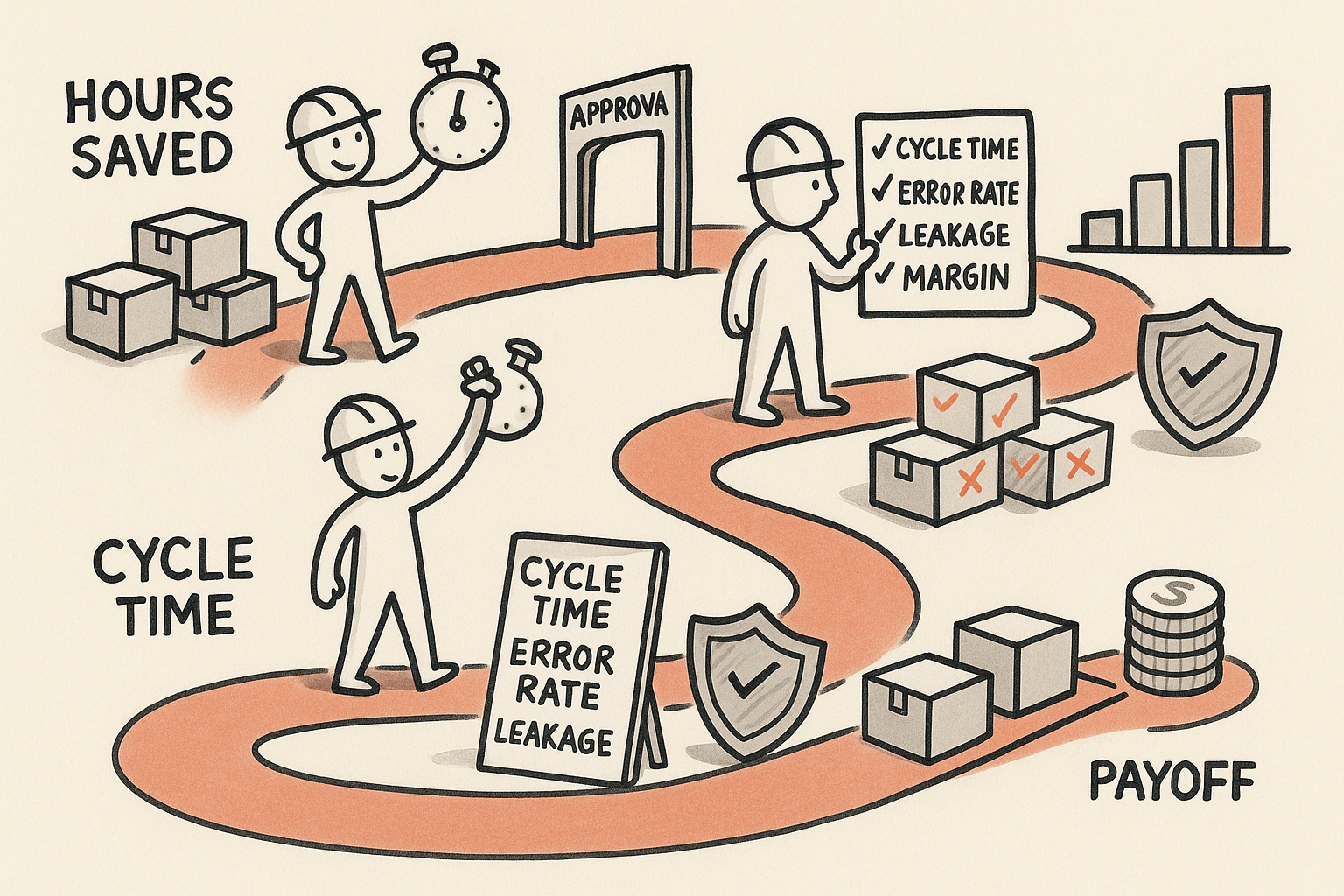
I have nothing against “hours saved” as a directional signal. It is just not a business metric. It is a proxy for activity, not for outcomes. And in many real organizations, the hours do not even disappear. They get reallocated, renamed, and absorbed by the next constraint.
When I ran an international business unit in smart-building and connected controls, and later when I owned operations across engineering, supply chain, production, and service in electrification and energy storage, the scoreboard was never effort. It was delivery, cost, quality, and cash. AI should be held to the same standard. Otherwise you get a portfolio of clever copilots, a bigger attack surface, and no durable margin.
My thesis is simple: if your AI “win” metric is hours saved, you will miss both the P&L and the risk. Measure AI on earnings quality, then design the operating model so the gains stick.
Why “hours saved” fails as a management metric
Hours saved is attractive because it is easy to tell a story. It is also easy to game.
- It ignores the constraint. In most teams, the constraint is not typing. It is decisions, approvals, handoffs, and rework.
- It hides quality loss. If AI makes people faster at producing incorrect work, your organization becomes efficiently wrong.
- It does not map to cash. The P&L improves when cycle time drops, defects drop, leakage closes, or revenue per constrained head rises. Not when someone “feels” faster.
- It creates unmanaged risk. You can ship a side tool with no audit trail, no exception handling, and no rollback, then discover the cost in customer credits, compliance findings, or brand damage.
In manufacturing and industrial tech, nobody accepts “we saved operator hours” as a release criterion. You prove throughput at spec. You prove scrap is stable. You prove safety interlocks work. The same discipline needs to show up in AI deployments.
Score AI like a CFO: earnings quality, not activity
If you want CFO-grade governance without turning it into bureaucracy, start with four measurable categories. They translate across SaaS, fintech, and industrial operations.
1) Cycle time: where cash and capacity are hiding
Pick end-to-end processes where time converts to money:
- Order-to-cash. Quote accuracy, contract turnaround, invoicing speed, dispute resolution.
- Close-to-report. Reconciliations, journal preparation, variance explanations.
- Support-to-resolution. First response time, time to resolution, deflection with verified correctness.
AI that reduces cycle time without increasing defects is the closest thing to “free capacity” you will ever find.
2) Error and defect rate: the hidden tax on every “productivity” claim
Track quality the way a factory tracks scrap and rework:
- Rework percentage per workflow stage
- Credits, refunds, and goodwill adjustments
- Escalations per 100 cases
- Defects found after release (not just in testing)
As a former QA and test leader in consumer electronics and HVAC controls, I learned that speed without a quality gate is not progress. It is a faster path to returns, brand erosion, and field fixes. AI can amplify that dynamic because it produces plausible output at scale.
3) Leakage: the P&L you lose quietly
Leakage is where operators win quarters without heroics. AI can help, but only if you measure it.
- Pricing and discount compliance. Deviations from policy, approvals bypassed, margin impact.
- Billing accuracy. Invoice defects, missed billables, incorrect tax handling (where relevant).
- Claims and warranty hygiene. Invalid claims accepted, valid claims delayed, cost per claim.
Leakage metrics are also risk metrics. They expose where AI is making decisions it should not be making.
4) Revenue or gross margin per constrained headcount
This is the scoreboard that matters when hiring is capped, specialist talent is scarce, or the organization is mid-transformation.
Measure improvement in the teams that are true constraints: key account managers, solution engineers, claims handlers, credit controllers, or the embedded specialists who are always the bottleneck in industrial programs.
The gains only stick when the operating model changes
I have seen the pattern across industrial tech, SaaS, and platform builds: tools do not transform a process. Ownership and controls do.
When I rebuilt and scaled an R&D organization across embedded software, cloud, electronics, mechanics, and QA, the biggest improvements came from clarifying who owned decisions and where the control points were. The same logic applies to AI in back office, support, engineering, and commercial workflows.
Here is the operating model I use. It is simple enough to run, strict enough to protect you.
- Name a decision owner per process. Not a steering committee. One accountable owner for “quote approval,” “refund approval,” “vendor onboarding,” “case closure,” or “release readiness.”
- Define control points. Where must a human review happen, and what triggers it? Thresholds should be explicit: amount limits, confidence bands, customer tier, novelty of request, regulatory sensitivity.
- Instrument audit logs. What did the AI see, what did it recommend, what was accepted, and by whom. If you cannot reconstruct a decision, you do not control it.
- Design exception handling. Every process needs a safe path when the model is uncertain, the data is missing, or the case is unusual.
- Put rollback and kill switches in place. If quality drifts, you revert to a known-safe mode. If you cannot stop it, you do not own it.
This is also why I keep coming back to the same principle: AI value is not in the org chart. It is in the stop button. I wrote more about this in AI Value Isn’t in the Org Chart. It’s in the Stop Button and in AI Moderation Needs an Error Budget and a Kill Switch.
A practical lens: treat AI like you would a production line
In my years in power electronics, quality leadership taught me a mindset that transfers perfectly to AI: you do not “trust” a system. You qualify it. You monitor it. You bound it. You prove it stays within spec.
So I ask operators to translate their AI initiative into production terms:
- What is the unit of work? A support case, an invoice, a design change, a test report, a claim.
- What is throughput? Units per day, per person, per queue.
- What is quality? Defects per 100 units, severity-weighted.
- What is the error budget? The tolerated defect rate before you throttle back or stop.
- Where is the safety interlock? The step that prevents a bad output from shipping, paying, or committing.
Once you frame it this way, “hours saved” becomes a side effect, not the goal.
What I would implement this quarter (a checklist)
If you are a board member or an operator and you want this to be real within one quarter, here is the minimum set of moves.
1) Pick one constrained process and one metric family
Do not start with “everyone gets a copilot.” Start where the business feels pain and where measurement is possible. Choose one of the four metric families: cycle time, defects, leakage, or margin per constrained headcount.
2) Establish a baseline with ugly honesty
Measure current cycle time and defect rate end-to-end. Include rework and escalations. The baseline is your contract with reality.
3) Draw the decision boundary
Write down what AI can propose, what it can draft, and what it can decide. Most organizations let this boundary drift until something breaks. Do it explicitly.
4) Implement control points and a kill switch before scaling
Do not negotiate this. The audit log, exception path, and rollback are part of the product. If you would not run a factory line without emergency stops, do not run AI workflows without them.
5) Report two dashboards: throughput and quality
One dashboard for speed and capacity, one for defects and leakage. If you only report the first, you will be surprised by the second.
In my venture builds, including Shopeno and IBHQ, this discipline is what keeps small teams effective. You cannot afford uncontrolled risk when headcount is tight. You also cannot afford vanity metrics. You need controllable systems that compound.
The opinion I will defend
AI should be managed like any other production system that touches customers and cash. Measure it on throughput and quality. Put control points where decisions become commitments. Install a stop button that actually stops.
If you do that, you will still get productivity. You will just get it in the form that matters: faster cycles, fewer defects, less leakage, and higher margin per constrained team. That is the kind of AI “win” a CFO can trust and an operator can scale.
Newsletter
Working notes, straight to your inbox.
Occasional, no-noise notes on leadership, execution, and applied AI — from the field, not the sidelines.