15 July 2026 · 8 min read
The Fastest Way to Lose Quality Is to Treat Suppliers Like a Contract Problem
Contracts set the floor. Weekly operating behavior sets the ceiling.
I have seen supplier relationships go bad in two very different ways.
The first is obvious: unclear specs, vague acceptance criteria, no audit rights, no liability. That is a contract problem.
The second is quieter and more expensive: the contract is fine, the supplier is “approved,” and yet quality drifts, delivery slips, and every meeting turns into negotiation theater. That is an operating system problem.
When I ran operations in electrification and energy storage, and earlier when I spent eleven years in power electronics across quality and engineering, I learned a simple rule. If you treat suppliers like legal counterparties, you will get legal behavior. Minimum compliance. Maximum defensiveness. Slow learning. And a lot of email.
If you treat suppliers like an extension of your operating system, you can get reliability without constant renegotiation. Not by being soft. By being specific.
Why contracts fail as a quality tool
A contract is a snapshot of risk allocation. It is not a mechanism for daily control.
Quality is produced by routines. The cadence of measurement. The speed of escalation. The discipline of root-cause. The way engineering, production, and procurement make decisions under pressure. None of that is solved by adding a clause.
In industrial and hardware-heavy businesses, the failure mode is predictable:
- Specs are interpreted, not executed. Two teams read the same requirement and build two different products.
- Issues are discussed, not owned. “We will look into it” becomes the default posture.
- Escalation is emotional. Problems get attention only when someone gets angry enough.
- Corrective actions are paperwork. A report is produced, the line keeps running, and the same defect returns three weeks later.
This is why quality often degrades even with “strong contracts.” The contract is not where the work happens.
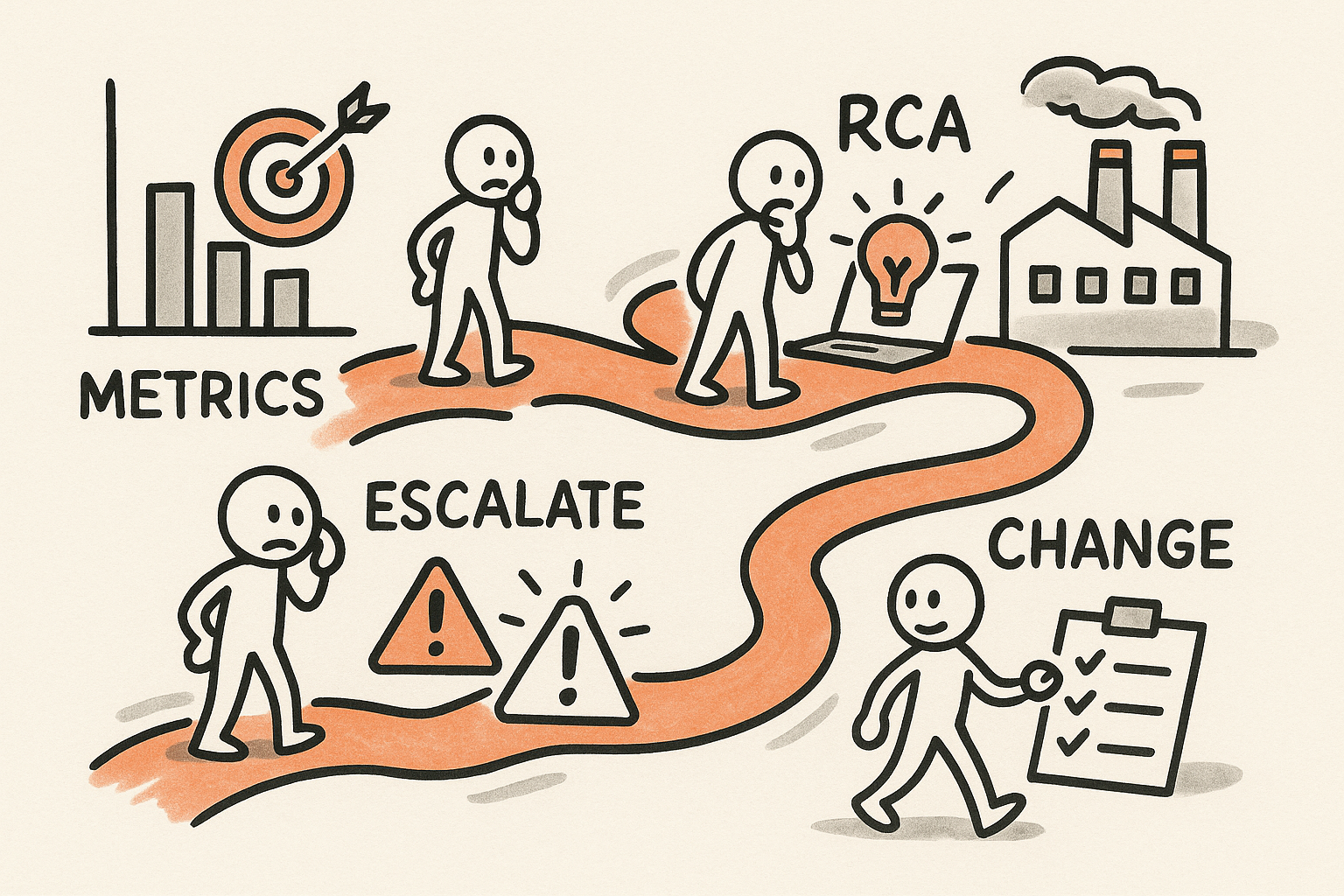
The supplier OS: four routines that actually protect quality
What worked for me was treating supplier performance like an operating system with a few non-negotiable routines. You can implement this with a spreadsheet, a weekly call, and the will to keep it boring.
Here is the structure I keep coming back to.
1) Shared metrics with one definition each
If you do not share the same definition of “good,” you are not managing quality. You are debating it.
I push for a single page of metrics that both sides accept, with definitions written in plain language. Examples that tend to matter in manufacturing and industrial tech:
- Incoming quality. Defect rate by defect type, not just a rolled-up percentage.
- Escape rate. What made it past your incoming inspection and showed up in production or in the field.
- Delivery reliability. On-time in-full, measured the same way on both sides.
- Response time. Time from issue raised to containment action, not to “analysis started.”
The key is not the metric list. The key is one definition each. If the supplier can game the metric, they will. Not because they are evil. Because incentives are stronger than intentions.
2) Escalation paths that do not depend on personality
Most supplier escalation is informal. That is why it becomes political.
When I ran an international business unit in smart-building and home automation, we depended on external production and specialized component suppliers. The only way to keep reliability was to build escalation that triggered on data, not on who shouted the loudest.
A practical model:
- Level 1: Operational owner to operational owner within 24 to 48 hours.
- Level 2: Quality lead and engineering lead join within 72 hours if containment is not in place.
- Level 3: Management review if the same defect class repeats or if delivery risk crosses a threshold.
Write down the thresholds. Publish them. Then follow them.
This does two things. It removes drama, and it makes “doing nothing” impossible.
3) Joint root-cause that ends in process change, not slides
I am a fan of structured problem solving, but only when it changes reality.
Root-cause should be a short loop:
- Containment: protect the customer and your line immediately.
- Root-cause: prove it with evidence, not opinions.
- Corrective action: change the process, tooling, test, or spec.
- Verification: show the defect cannot happen again under the same conditions.
In practice, the biggest improvement comes from making root-cause joint. Not because you want to be nice, but because many failures live in the interface: your drawing ambiguity, your tolerance stack-up, your test coverage, their process capability, their operator training, the packaging, the transport.
If you force the supplier to do all analysis alone, they will optimize for blame avoidance. If you do it all yourself, you will miss their process reality. Joint work is faster.
4) A change-control handshake that respects physics and software
In connected products, quality failures are often “small changes” that were never treated as changes. A component substitution. A firmware tweak. A new resin. A different test jig. A new operator on a night shift.
You need a handshake that makes changes explicit and reviewable. Not heavy. Just consistent:
- What changed?
- Why did it change?
- What could it break (performance, safety, compliance, service)?
- How will we test it (sample size, conditions, acceptance)?
- Who signs off?
This is where hardware companies borrow a lesson from good software teams: if you cannot control releases, you cannot control outcomes.
I wrote elsewhere that operating discipline beats connected sensors when uptime is the goal. Supplier quality is the same story. Tools help. Discipline decides.
A lived pattern: quality improves when the week becomes predictable
One pattern I have seen repeatedly is that supplier quality improves fast when the week becomes predictable for everyone involved.
In my earlier years in power electronics, quality issues often surfaced as field returns or commissioning failures. Later, in consumer electronics and smart building controls, issues showed up as production stops, unstable yields, or “it passes in our lab but fails in yours.” Different products, same mechanism.
The turning point was rarely a new clause. It was installing a weekly rhythm:
- Monday: performance review on the shared metrics page.
- Midweek: joint deep dive on the top one or two issues, with evidence on the table.
- Friday: confirm containment, confirm next actions, confirm owners.
After a few weeks, something important happens. People stop improvising. They start anticipating. The supplier brings data before you ask. Your team stops escalating through procurement for technical problems. Engineering stops treating supplier issues as “someone else’s mess.”
This is the real value of the supplier OS. It turns quality from a set of debates into a set of routines.
Where leaders usually break the system
Even good teams sabotage this approach in three common ways.
They outsource ownership to procurement
Procurement is essential, but procurement cannot own technical reality alone.
Supplier quality is cross-functional by nature. It needs engineering for specs and design intent, operations for flow and capacity, quality for detection and prevention, and procurement for commercial leverage and governance.
If you put the whole problem on procurement, you will get price pressure and paperwork. You will not get process capability.
They confuse dashboards with management
Metrics are not control. Metrics are the start of a conversation.
The only dashboards that matter are the ones linked to action: thresholds, owners, deadlines, and verified closure. Otherwise you are just observing your decline in high resolution.
They renegotiate instead of redesigning the interface
When quality drops, the instinct is to renegotiate: penalties, credits, stronger wording.
Sometimes that is necessary. But most of the time the faster fix is to redesign the interface:
- Make acceptance criteria testable.
- Clarify handoffs (who provides what, when, and in what format).
- Lock change control.
- Agree on the escalation ladder.
That is operating design, not legal design.
A simple checklist you can implement this quarter
If your business depends on external production and you want reliability without living in renegotiation cycles, here is the quarter plan.
- Create a one-page supplier scorecard with 4 to 6 metrics and written definitions.
- Install a weekly supplier performance cadence with a fixed agenda and pre-read expectations.
- Define escalation thresholds that trigger automatically on data (repeat defects, delivery risk, response time breaches).
- Mandate joint root-cause for the top issues, starting with containment and ending with verified process change.
- Implement lightweight change control for components, processes, test, packaging, and firmware.
- Assign internal owners across engineering, quality, operations, and procurement. One throat to choke per issue, but not one function to blame.
If you want to push this further with modern tooling, treat supplier data like a contract too. I have seen AI initiatives fail in manufacturing because the “data contract” was missing, not the model. The same thinking applies here. A supplier OS needs clean definitions, traceability, and disciplined inputs. Otherwise automation just scales confusion. This is why I keep coming back to operating checklists in technology, including AI architecture as an operator’s checklist.
My opinion: contracts set accountability, operating systems create reliability
Use contracts for what they are good at: setting boundaries, aligning incentives, and creating accountability when things go wrong.
Do not use contracts as your primary quality strategy. That is slow, adversarial, and reactive.
Reliability comes from a shared operating system: clear metrics, predictable cadence, data-driven escalation, and joint root-cause that changes the process. When you install those routines, quality stops being a monthly surprise and becomes a managed output.
That is the difference between “supplier management” and operations.
Newsletter
Working notes, straight to your inbox.
Occasional, no-noise notes on leadership, execution, and applied AI — from the field, not the sidelines.