18 March 2026 · 7 min read
AI Moderation Needs an Error Budget and a Kill Switch
Good intentions do not protect users. Control systems do.
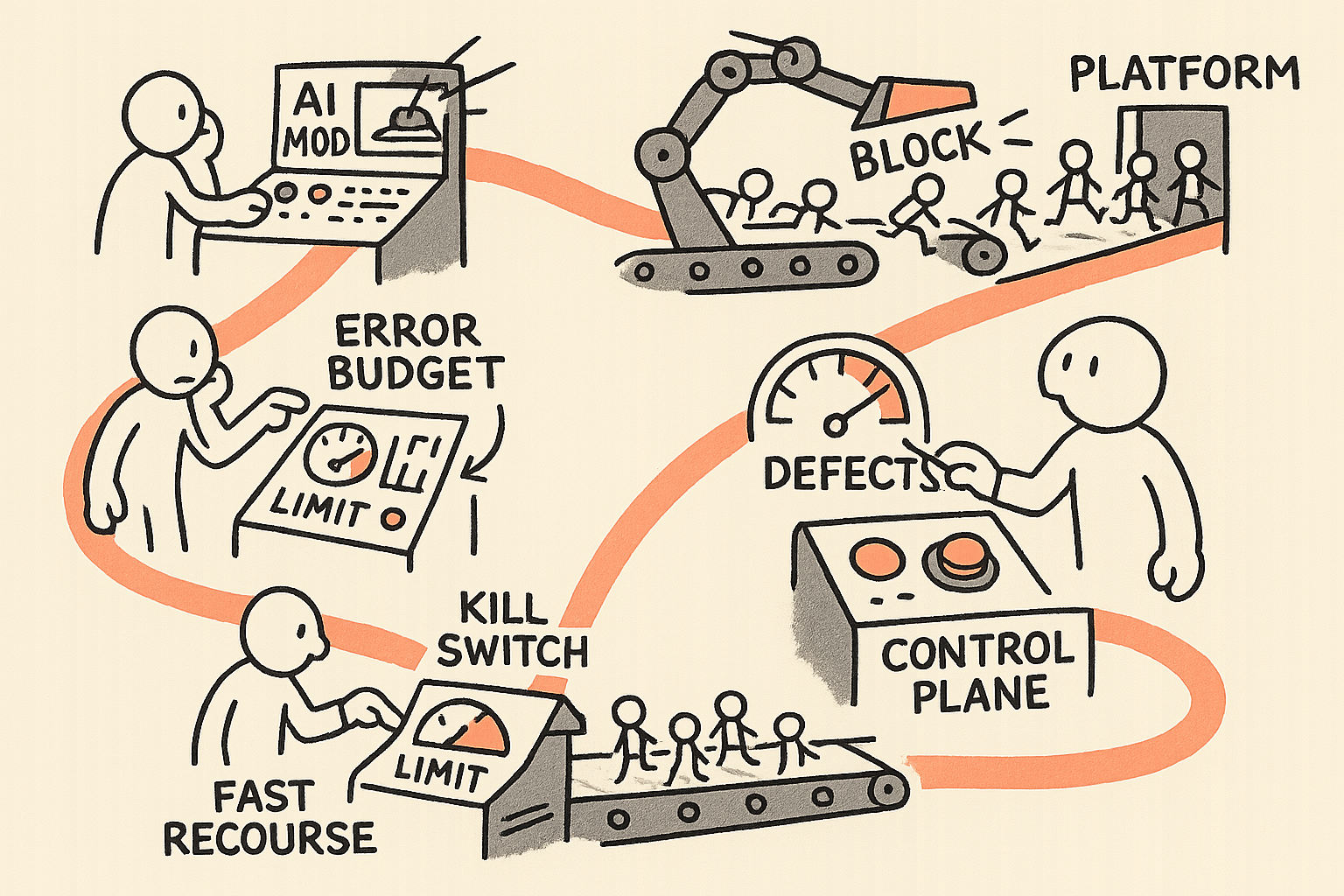
AI moderation is often discussed like ethics. In operations, it is control.
If your system can remove content, restrict reach, or suspend an account, it is not “just” a model. It is an actuator. And every actuator needs three things before it touches live users: an error budget, a kill switch, and a recourse workflow that restores service fast.
I learned this lesson long before AI. In my QA and test management years in consumer electronics, and earlier across power electronics for automation and HVAC, we treated automation as a production line. A false positive was a defect. A missed defect was also a defect. Either way, you had a measurable cost, a root cause, and a stop condition. Trust and Safety systems deserve the same discipline, because the output is not a dashboard metric. It is a user’s ability to participate in a platform.
Moderation is a revenue critical production line
Operators underestimate the business impact of false positives in moderation because they look “soft.” They are not.
- False positives create churn. You block legitimate users and they do not come back. Even if they do, trust is damaged.
- False positives create support load. Every wrongful action becomes a ticket, a manual review, and a backlog you never fully burn down.
- False positives create reputational debt. Your best users learn to self-censor, or they move the conversation elsewhere.
- False positives create internal confusion. Sales, partnerships, and community teams cannot explain what the product will do, because the product is not predictable.
When I ran an international business unit in smart building and home automation, reliability was never limited to hardware. Our connected sensors and controls were only “good” if customers could predict behavior across edge devices, cloud, and support. Moderation is the same kind of reliability problem. The model is only one component. The system is the product.
Define the error budget in plain business terms
An error budget is not a research metric. It is a business contract: how much wrongful action you will tolerate per day or per week before you stop the line.
I like to define budgets at three layers:
- User harm budget. Maximum number of wrongful suspensions, wrongful removals, or wrongful blocks allowed in a time window. Not percentage only, absolute count matters because impact clusters.
- Operational budget. Maximum number of appeals you can process within the promised SLA, and maximum backlog age.
- Reputational budget. Maximum number of high-visibility failures (for example, wrongful actions against long-tenured users, verified accounts, or paying customers) before you trigger executive review.
Then make it executable. Every budget needs:
- Instrumentation. You cannot manage what you do not measure. Log every decision with model version, policy version, features, confidence, and enforcement action.
- Thresholds that map to actions. If you hit 50 percent of the budget, you tighten rollout. If you hit 100 percent, you freeze. If you exceed it, you rollback.
- A single owner. Not a committee. One accountable operator who can stop the line.
This is the same pattern I used when I later rebuilt and scaled an R&D organization. You can debate quality all day. Or you can define the budget, measure it, and force the organization to respond when it is exceeded.
Ship with shadow evaluation and explicit stop conditions
Most moderation failures are not “the model was imperfect.” They are “we deployed without a controlled ramp, without shadow evaluation, and without a stop button that anyone was willing to press.”
In industrial environments, we never put automation in charge of outcomes on day one. We ran it in parallel and compared it to the known-good process until we trusted it. That mindset ports cleanly to AI moderation:
- Shadow mode first. The model makes decisions, but humans or the existing rules engine remains the source of truth. You measure divergence and investigate the top error clusters.
- Gated rollout. Start with low-severity actions only (labeling, deprioritization, friction). Do not begin with irreversible actions (suspensions, bans) unless you can reverse them in minutes.
- Stop conditions before launch. Write them down. “If wrongful suspensions exceed X in 24 hours, rollback.” “If appeals breach SLA for Y hours, freeze new enforcement.”
- Change control. Treat model updates like production releases. Version everything. If you cannot answer “what changed,” you cannot do incident management.
Boards and owners should ask one question that cuts through everything: What are the stop conditions, and who has the authority to trigger them?
This links directly to my broader view that AI value is operational, not organizational. I wrote more on that in AI Value Isn’t in the Org Chart. It’s in the Stop Button.
The kill switch is a product feature, not an incident hack
A kill switch is not “we can turn it off if needed.” That is a hope. A kill switch is engineered.
In practice, you want at least four switches, each with a clear blast radius:
- Global enforcement off. The model can still score content, but cannot take actions.
- Action-class off. Disable only the highest severity actions (for example, suspensions) while keeping softer interventions.
- Policy slice off. Disable a problematic policy area (for example, adult content detection) without touching others.
- Model version rollback. Instant revert to the previous known-good version, including prompts, thresholds, and feature pipelines.
The key is speed and confidence. If rollback takes hours, you will hesitate. If you hesitate, the incident grows. In manufacturing, that is how scrap piles up. In SaaS, that is how churn piles up.
When I ran operations in electrification and energy storage, stop conditions were not theoretical. If you suspect a process shift, you stop, you contain, you verify. You do not wait for a weekly meeting. Moderation needs the same reflexes, even if the “product” is digital.
Appeals are not customer support, they are your calibration loop
An appeal workflow is usually treated as a cost center. It is actually a quality system. It is how you detect drift, policy ambiguity, and model blind spots.
Design it like a recourse mechanism with real guarantees:
- Fast restoration for high-confidence mistakes. If your system flags an action as low confidence, route it to review before enforcement, or restore automatically when an appeal arrives.
- Visible timelines. Users accept strict rules more easily than unpredictable outcomes. Publish SLAs, then meet them.
- Structured feedback. Every overturned decision should produce a labeled data point tied to the exact policy clause and the exact model version.
- Post-incident clean-up. If you rollback a model, you should also audit the last N actions and proactively restore accounts where the confidence was low or the error cluster is known.
In venture building, I apply the same idea. At Shopeno and IBHQ, I do not treat user complaints as noise. I treat them as signal about process gaps. Appeals are that signal, at scale, if you capture them correctly.
A quarter-ready checklist for operators and boards
If you are responsible for a platform with AI moderation, here is what I would implement this quarter.
- Write the harm budget. Absolute counts per day for wrongful removals and wrongful suspensions. Include thresholds and actions.
- Instrument decisions end-to-end. Model version, policy version, confidence, features, and the enforcement outcome.
- Run shadow evaluation. Measure divergence against human review or the current system until the top error clusters are understood.
- Stage enforcement. Start with reversible actions, then ramp to irreversible actions only with proven recourse speed.
- Engineer four kill switches. Global off, action-class off, policy slice off, and model version rollback.
- Ship an appeal SLA. Make it visible. Fund it. Use overturned cases as calibration data.
- Define incident ownership. One accountable operator, one on-call rotation, one playbook.
This is operational discipline. The same discipline behind any reliability contract, whether you are shipping industrial controllers, connected sensors, or a SaaS platform. If you want a related framing from the physical world, my view is consistent with Ruggedization Isn’t a Checkbox. It’s a Reliability Contract You Pay For and Enforce.
My opinion: treat moderation like automation, or do not automate it
AI moderation will always make mistakes. The question is whether your organization is built to detect, contain, and reverse those mistakes before they become user harm at scale.
Good intentions do not create safety. Control systems do. If you cannot state your harm budget, show your stop conditions, and restore users fast, you are not running AI moderation. You are gambling with your customer base.
Ship the model only after you ship the control plane.
Newsletter
Working notes, straight to your inbox.
Occasional, no-noise notes on leadership, execution, and applied AI — from the field, not the sidelines.