9 July 2026 · 7 min read
Pricing Is Product Management in Disguise
If you cannot explain why you charge what you charge, sales will invent a pricing system on the fly.
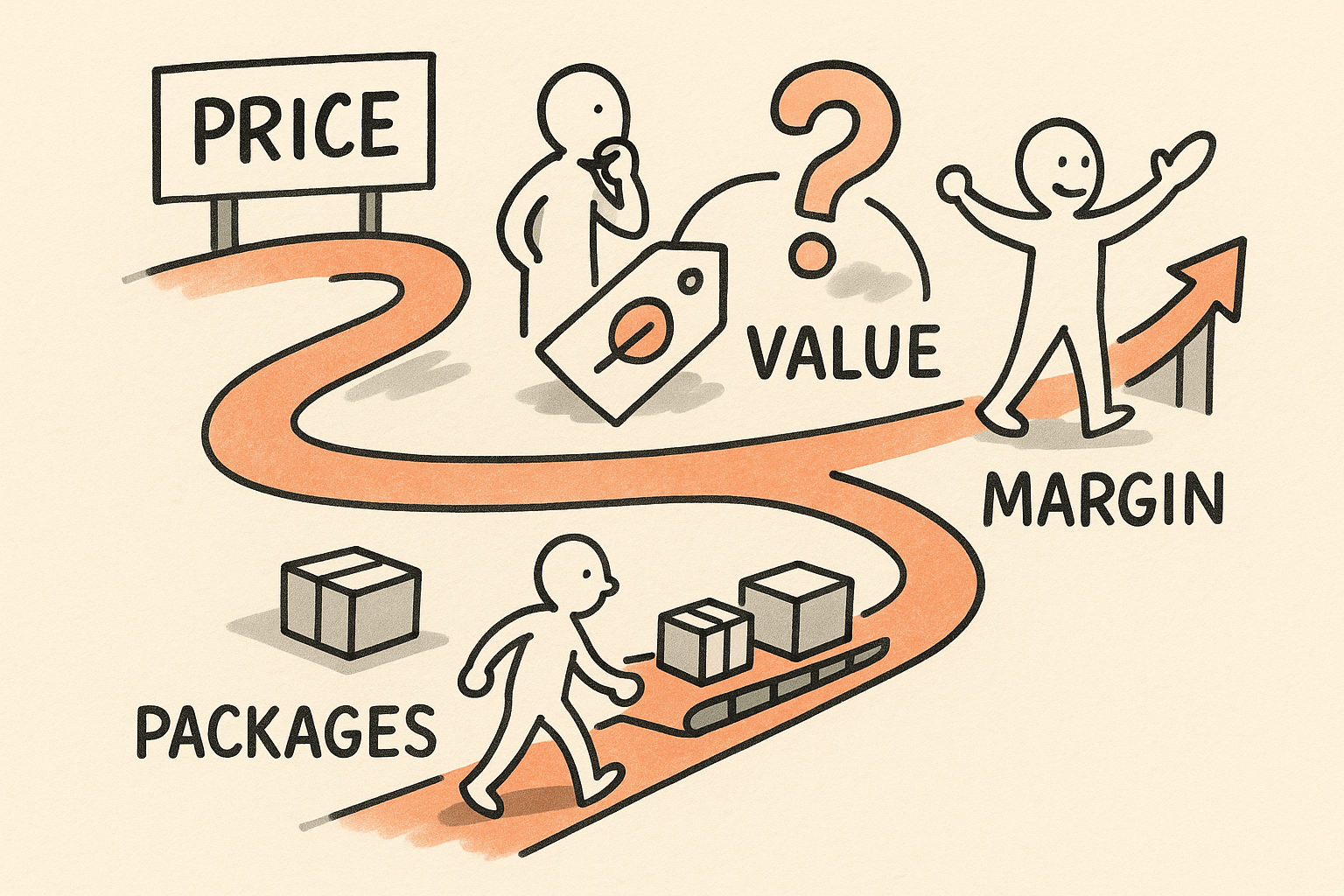
I have learned to treat pricing with the same respect I give a product roadmap. Not because it is elegant. Because it is operationally necessary.
When pricing is vague, every quote becomes a one-off. Discounting becomes the real product. Sales ends up carrying your positioning decisions on their backs, and they will do what any good salesperson does under uncertainty: close the deal. That is not a moral failure. It is a management failure.
I saw this pattern from different angles. In industrial technology, pricing drift shows up as margin leakage across configurations, service terms, and delivery promises. In SaaS, it shows up as a packaging mess, a pricing page nobody trusts, and renewals that feel like negotiations instead of a system. In both cases, the same root cause appears: nobody is running pricing like a product.
My thesis is simple: pricing is product management in disguise. It needs hypotheses, segmentation, packaging, experiments, and clear ownership. It also needs a tight connection to gross margin and delivery cost, otherwise you are just writing stories with numbers attached.
The moment you cannot explain the price, you lose control
When I ran a Danish business unit in a European smart-building and home-automation group, I had full P&L responsibility. We shipped connected sensors and building controls across multiple countries. The product portfolio looked coherent on slides, but reality was messier: different channels, different customer types, different service expectations, and different competitive anchors.
In that environment, the fastest path to chaos is to let pricing be “what we did last time”. The second fastest path is to let it be “what sales thinks will win this quarter”. You end up with a shadow pricing system built from exceptions: special discounts, bespoke bundles, free services, extended payment terms, and vague commitments that later land in operations.
Once this happens, you are not managing price. You are managing regret.
So I started asking one question that sounds simple but is brutally revealing: why do we charge what we charge, for this customer, for this scope, with these terms? If the answer is a story instead of a testable rationale, you do not have pricing. You have improvisation.
Run pricing like a product: ownership, backlog, and releases
The first shift is mental. The second is structural.
Pricing needs a single accountable owner. Not “finance plus sales plus product in a committee”. Committees can review. They cannot own. The owner can sit in product, commercial, or general management, but they need authority to change packaging, discount rules, and approval flows.
Then you build a pricing backlog. Literally. A prioritized list of pricing work items the same way you would manage features:
- Segmentation decisions: which customer types deserve different value narratives and different price metrics.
- Packaging decisions: what is included, what is optional, what is gated, and what is non-negotiable.
- Policy decisions: discount bands, deal desk rules, approval thresholds, and exceptions that must expire.
- Instrumentation: what you will measure so pricing becomes a system, not an argument.
Finally, you ship pricing in releases. Not once per year. Not every time you panic. Pricing releases can be small and frequent: a clarified package boundary, a new add-on, a revised metric, a cleaned-up quote template, a tighter discount policy. Small releases reduce fear and reduce the blast radius.
Four pricing artifacts I rely on (because arguments are expensive)
Over time, I started relying on four simple artifacts. They are not fancy. They prevent endless debate and force decisions into the open.
1) The value metric statement
A single sentence: “We charge based on X because X is the best proxy for value delivered.” If you cannot write it, you are not done.
In SaaS, that might be a usage metric. In industrial businesses, it might be capacity, throughput, or a defined scope of supply with clear boundary conditions. The point is not to be clever. The point is to be defensible.
2) The packaging boundary document
One page that says what is in the base offering, what is optional, and what is explicitly out of scope. This is where margin is protected.
I learned this the hard way in industrial contexts, where “small” extras become recurring cost. A promise made during a sales conversation can turn into months of engineering support, special QA, custom documentation, or service exceptions. If you want a clean P&L, you need clean boundaries.
3) The discount ladder with an expiry
Discounting is not evil. Unbounded discounting is. The ladder sets ranges, requires a reason code, and forces an expiry date for any exception.
The expiry matters. Otherwise every exception becomes a precedent, and precedents are how your list price dies quietly.
4) The margin waterfall that sales can understand
If sales cannot see how terms and scope impact gross margin, they will optimize for revenue. That is rational. Your job is to give them a model that makes margin visible and actionable.
When I ran operations in electrification and energy storage as a former COO, cost drivers were not abstract. Engineering time, production complexity, supply chain constraints, service commitments, and warranty exposure were real. A margin waterfall that ties commercial terms to operational cost is how you stop donating value without turning sales into accountants.
Controlled experiments, not pricing debates
Once you have the basics, you can start behaving like a product team: make a hypothesis, test it, and keep what works.
I like experiments that are hard to game and easy to measure:
- Packaging A/B: two bundles with clear differences, offered by rule to a defined segment.
- Fence tests: a new price point paired with a constraint (support tier, SLA, lead time) to see if customers really value the upgrade.
- Channel consistency checks: same segment, different channel, compare discount behavior and churn or repeat purchase.
- Term monetization: price the things you currently give away, like faster delivery, extended warranty, higher service levels, or integration support.
Experiments fail when companies try to test everything at once. Pricing is a system. Change one lever, observe, then change the next.
In my venture work, that discipline is non-negotiable. With Shopeno, where the model is 0 percent cost and 0 percent commission for local shop owners, pricing is not just a number. It is positioning, distribution, and trust. You cannot “discount” your way to clarity when the core promise is already aggressive. That forces a product-style approach: define the value exchange precisely, decide what is monetized (and why), and keep the system coherent.
The quarterly checklist I use to keep pricing sane
Here is the operating cadence I would implement this quarter if pricing feels slippery. This is for owners and operators who want growth without value donation.
- Write the pricing narrative in plain language: one paragraph explaining value, segmentation, and the metric. If it reads like marketing, rewrite it.
- Freeze the package boundaries: publish what is in and out, and make quoting depend on it.
- Install a discount ladder: set thresholds, reasons, approval, and expiry dates.
- Define three segments maximum to start: the goal is repeatability, not academic precision.
- Pick one experiment: packaging, terms, or add-ons. Run it for a defined period with clean measurement.
- Review margin waterfall by segment: not just average margin. Look for where complexity and promises eat profit.
- Kill one exception: remove one recurring “special case” from the system. This is often where the real leverage is.
If you want a parallel idea in another domain, I see the same operational need in AI programs: the winning teams treat architecture as a checklist, not a diagram. The same discipline applies here. Pricing is an operating system. If you do not own it, it will own you. (Related: AI Architecture Isn’t a Diagram. It’s an Operator’s Checklist.)
My opinion: stop delegating pricing to the field
I am not arguing for rigid pricing that ignores reality. I am arguing for explicit pricing decisions that match your product boundaries and your delivery cost. Flexibility is fine when it is governed. Chaos is expensive when it is normalized.
If you cannot explain why you charge what you charge, you are not “customer-centric”. You are undecided. And sales will decide for you, one deal at a time.
Treat pricing like product management. Give it an owner. Build the artifacts. Run controlled experiments. Tie every change to margin outcomes and delivery reality. Then you can grow without donating value.
Newsletter
Working notes, straight to your inbox.
Occasional, no-noise notes on leadership, execution, and applied AI — from the field, not the sidelines.