16 June 2026 · 6 min read
Tokenized Equities: The Tech Is Easy. The Control Plane Is the Product.
If you want tokenized stocks to be investable, sell operational assurance, not a blockchain wrapper.
I have built and run systems where failure is not a “bug.” It is a recall, a service crisis, a regulator on the phone, or a balance sheet hit. That experience shapes how I look at tokenized equities.
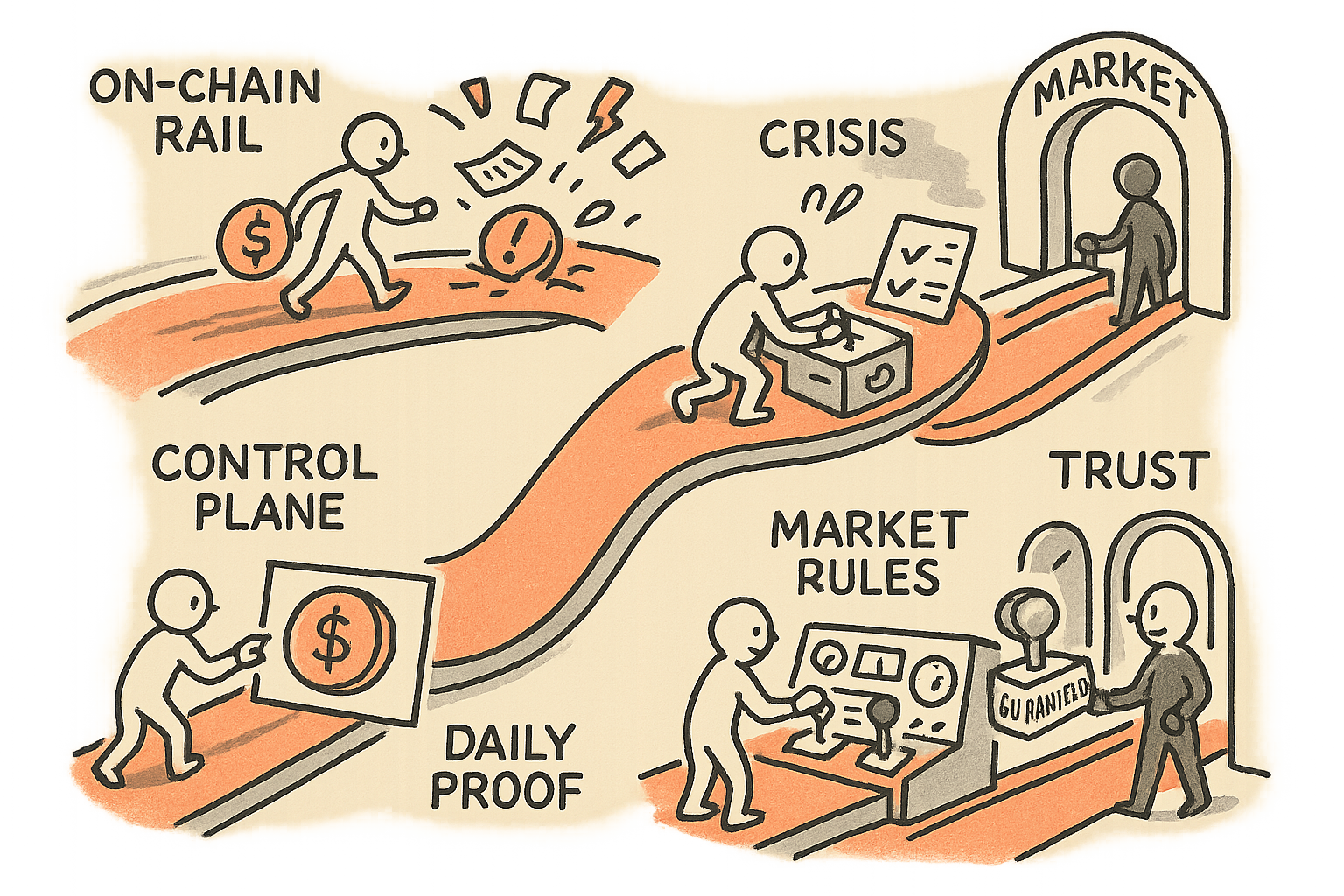
The token itself is not the hard part. Issuing a representation of a share on-chain is straightforward. The hard part is everything around it: controls, surveillance, reconciliation, corporate actions, settlement integrity, incident response, and the ability to prove, every day, that the system behaved correctly.
That is why I pay attention when credible operators package tokenized equities into something that looks and feels adoptable by real institutions. The race is not just about infrastructure. It is about who can offer a credible operating model that a broker, an exchange partner, and a regulator can live with.
My opinion is simple: in tokenized equities, the control plane is the product. The rest is plumbing.
The market does not buy tokens. It buys guarantees.
When I ran operations in an electrification and energy storage context, the “product” was never only hardware. Customers and partners bought delivery reliability, service readiness, and predictable performance under real constraints. In industrial systems, you win by making risk boring.
Tokenized equities need the same shift. Boards and operators should stop asking, “Is the blockchain fast enough?” and start asking, “Can I run this market safely at scale?”
The uncomfortable truth is that most failures in financial platforms are not caused by lack of throughput. They come from weak controls and unclear accountability:
- Who can mint, burn, freeze, or reverse? Under what conditions, with what approvals, and with what audit trail?
- How do you reconcile the on-chain position with the off-chain legal reality? What is the source of truth, and how do you prove it?
- How do you handle corporate actions? Splits, dividends, mergers, voting, and odd-lot edge cases.
- What happens during an incident? Trading halts, rollbacks (if any), customer comms, regulator comms, and post-mortems.
If you cannot answer these crisply, you do not have a product. You have a demo.
Define the control plane like an operator, not a whitepaper
I use “control plane” the same way I used it when I owned QA and test across hardware and software, and later when I rebuilt an R&D organization across embedded, cloud, electronics, mechanics, and QA. The control plane is the set of mechanisms that make the system governable in the real world.
In tokenized equities, that governability must be explicit. Not implied. Not “handled by partners.” Explicit, testable, and contractually committed.
Here is a practical way to frame it for a board or exec team. Your control plane should cover four layers:
- Market integrity controls: surveillance, manipulation detection, abnormal activity flags, and rule enforcement.
- Asset integrity controls: issuance limits, token lifecycle management, corporate actions processing, and custody boundaries.
- Operational integrity controls: reconciliations, incident management, change management, and access governance.
- Customer integrity controls: suitability constraints (where applicable), disclosures, transparency on pricing and liquidity, and complaint handling.
Most teams build layer one as a feature list. The winners build layers two and three as a disciplined operating system. That is what makes the asset credible.
“Turnkey” only matters if the runbook is turnkey
In my venture work, including building IBHQ in fintech and Shopeno in commerce, I learned a consistent lesson: platforms do not scale on features. They scale on reduced operational load per customer. If every new customer requires heroics from engineering or operations, growth stalls.
So when a market offers a “turnkey platform,” I look for evidence of turnkey operations, not turnkey APIs. A partnership framed as a turnkey platform for tokenized U.S. equities is directionally aligned with what the industry needs, because it signals packaging and distribution of infrastructure. But the real test will be operational: can participants adopt it with clear controls, predictable onboarding, and unambiguous responsibility boundaries?
As a former CEO running a multi-country smart-building business unit, I spent more time than I expected on interfaces: not technical interfaces, but responsibility interfaces. Who owns what when something breaks. The same applies here. If you do not define those seams, you will fight them during every incident.
For tokenized equities, “turnkey” must include:
- A control catalog: a plain-language list of controls, their purpose, and who owns them.
- Evidence artifacts: logs, reconciliations, audit trails, and reporting that can be produced on demand.
- Change discipline: release gates, rollback plans, and an approval model for contract upgrades and permission changes.
- Runbooks: step-by-step procedures for halts, freezes, corporate actions, and customer-impacting events.
This is not paperwork. It is the product that compliance, counterparties, and risk committees actually buy.
A checklist you can apply this quarter
If you sit on a board, own a brokerage, or run a fintech product organization evaluating tokenized equities, here is the decision lens I would use. It is intentionally operational.
1) Start with the legal and economic truth, then map to tokens
- What exactly does one token represent, and what does the holder legally own?
- What are the redemption rules, and who can trigger them?
- What is the process when on-chain and off-chain records diverge?
2) Demand a daily proof loop
- What reconciles daily, automatically, and what requires human review?
- What are the tolerances and escalation paths?
- How is reconciliation evidence stored, and for how long?
3) Make corporate actions a first-class product area
- Who owns the corporate actions calendar and execution?
- How are fractional outcomes handled?
- How are customer communications triggered and approved?
4) Treat incident response as a feature
- Who can halt trading, freeze tokens, or block transfers, and what approvals are required?
- What is the target time to detect, decide, and act?
- Do you have post-incident review and permanent corrective action, not just a patch?
5) Price the control plane explicitly
- Is the vendor effectively giving controls away “for free” to win distribution?
- Or is there a clear commercial model tied to assurance, reporting, and operational workload reduction?
If the platform cannot answer these without hand-waving, it will struggle to earn serious liquidity. Liquidity follows trust, and trust follows controls.
My closing view: sell boring, win big
Tokenized equities will be won by the teams who embrace a slightly unsexy truth. The blockchain layer will commoditize. The differentiator will be an industrial-grade control plane that makes ownership, trading, and operations provable.
I have seen this pattern in industrial technology and in SaaS. When the core tech becomes “easy,” the operational system becomes the moat. That is also the cleanest path to institutional adoption: make risk boring, make incidents survivable, and make evidence easy to produce.
If you want a useful parallel, the same operator logic shows up in other asset-heavy domains where bankability depends on assurance. I wrote about that mindset in making grid-scale storage bankable, and the same checklist mentality applies to complex systems design in AI architecture as an operator’s checklist. Different domains, same truth: the control plane is where trust is manufactured.
Newsletter
Working notes, straight to your inbox.
Occasional, no-noise notes on leadership, execution, and applied AI — from the field, not the sidelines.