8 July 2026 · 6 min read
The Operator’s Playbook for Making Grid-Scale Storage Bankable
Treat interconnection as the critical path, underwrite revenue like a lender, and run O&M like a factory.
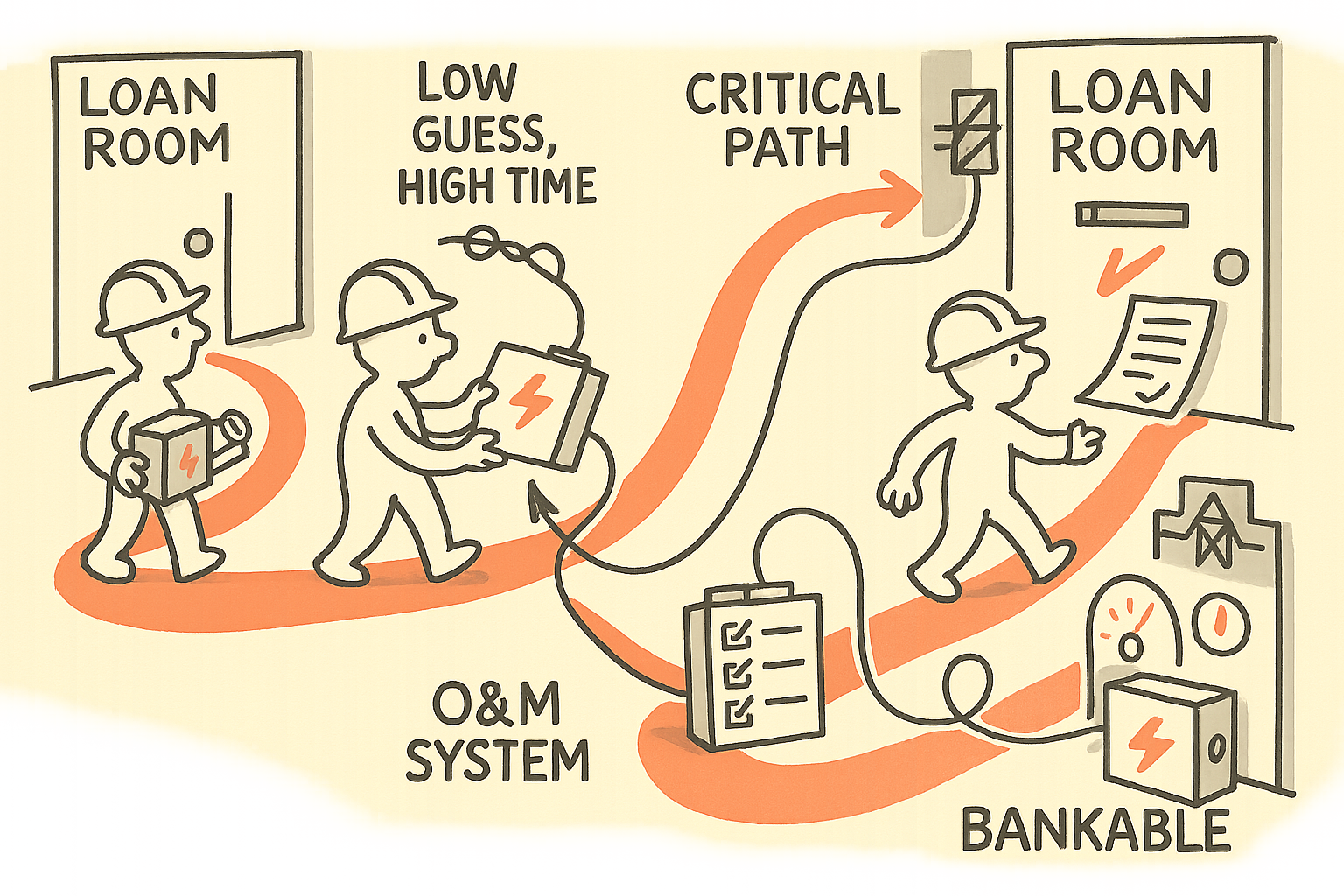
I’m bullish on grid-scale storage. I’m also allergic to PowerPoint bankability.
In energy storage, “bankable” is not a vibe. It’s a chain of decisions that reduces unknowns until a lender, an insurer, and a board can sign without holding their breath. When I look at the projects that make it through committee and the ones that stall, the pattern is consistent: the winners don’t magically have better technology. They have better execution on the boring constraints.
Today, storage is getting real procurement momentum. For example, Massachusetts utilities signed contracts totaling 4.5 GWh of energy storage. That’s not a science project. That’s a signal: buyers and regulators are moving, and the market is selecting for operators who can close risk.
Here is my operator’s playbook for making grid-scale storage bankable. Not “financeable in theory.” Bankable in the messy, real world.
1) Put interconnection on the critical path—or accept you’re speculating
Most teams say interconnection is “important.” Few treat it like the constraint that sets the entire project cadence.
Interconnection is where schedule risk hides, where capex can quietly expand, and where your revenue start date gets pushed quarter after quarter. And once COD moves, everything else moves with it: EPC availability, equipment pricing, staffing, insurance terms, even the credibility of your PMO.
As an operator, I run interconnection like a manufacturing bottleneck:
Single accountable owner. Not a steering committee. One person who wakes up responsible.
Dependency map in plain language. What decisions are waiting on which studies, what dates are real, and what dates are hope.
Weekly risk burn-down. Risks are not “tracked.” They are reduced. Every week something must move from unknown → known, or from high → medium.
Design-to-interconnect discipline. If the interconnection requirements drive export limits, reactive power needs, or protection schemes, then the plant design follows. Not the other way around.
This is not paperwork. It’s your revenue clock. If your interconnection timeline is fuzzy, your model is fiction.
2) Underwrite revenues conservatively—and separate “model” from “contract”
In storage, people love revenue stacking. It makes the spreadsheet look like a rocket ship.
Operators should do the opposite. Build a base case you can defend in a hostile room.
My rule: your bankability is defined by the worst month you can survive, not the best month you can pitch.
What does that mean in practice?
Prioritize contracted or clearly defined revenue streams. If it’s merchant, treat it as volatile. If it’s new market design, treat it as uncertain.
Use conservative availability and degradation assumptions. If you haven’t proven it in your operating context, don’t borrow against it.
Model curtailment and congestion as real. If the node can get messy, it will.
Stress-test with “boring” failures. Late commissioning, a bad batch, one inverter class issue, a BMS firmware rollback, spare parts lead time. These are the failures that kill DSCR quietly.
I’ve built and run SaaS and fintech ventures (IBHQ, Shopeno, and others). In those worlds, you can sometimes “iterate” your way out of a forecast miss. On the grid, iteration is expensive. Underwrite like a lender, even if you’re equity. It forces better engineering and better contracting.
3) Engineer availability like an industrial product, not a project
Availability is where storage economics live or die. And availability doesn’t come from slogans. It comes from an operating system that makes failures visible, repeatable, and fixable.
When I led quality and market performance in power electronics at a global industrial group, the lesson was clear: field issues are rarely “random.” They’re patterns you failed to capture early. When I later owned QA and test across hardware and software at a building-controls manufacturer, I saw how much pain you can avoid if you treat test coverage, traceability, and release discipline as non-negotiable.
For grid-scale storage, I like to break availability engineering into three layers:
A) Design for maintainability
Modularity over heroics. Can you isolate a container, string, or inverter without taking down the site?
Access and replacement time as design inputs. If it takes eight hours to safely reach a component, you just baked downtime into the plant.
Spare strategy tied to lead times. The best spare is the one you already have when the failure happens.
B) Build a release and change-control discipline
Firmware/software is part of asset risk. BMS/EMS/inverter updates need staged rollout, rollback plans, and clear ownership.
Configuration management. Know what is installed where. Always. “We think” is unacceptable in operations.
C) Run O&M like a factory
Daily management cadence. Short standups. Clear blockers. Fast escalation paths.
Top loss tree. The top five downtime drivers, updated weekly, with owners and countermeasures.
Mean time to detect and restore. Not just mean time between failures. Detection and restoration are operational skills.
If you want a parallel from AI: architecture is not a diagram. It’s a checklist operators can execute. Same in storage. The “plant” is hardware, software, people, and process. If you’re interested in that framing, my piece AI Architecture Isn’t a Diagram. It’s an Operator’s Checklist. covers the same operator logic in a different domain.
4) Make risk legible: align contracts, warranties, and operations
Boards and lenders don’t fear risk. They fear unpriced risk and unclear ownership.
When I ran a multi-country smart-building business unit as CEO, the recurring challenge was alignment: commercial promises, product reality, and operational capacity must match. If they don’t, you get margin leakage and escalations that consume leadership bandwidth.
In grid-scale storage, bankability improves when you do three alignment moves early:
Contract to your operating reality. If you can’t service a certain response time, don’t promise it. If you need remote access for diagnostics, bake it into agreements.
Warranties that match duty cycle. Don’t let the commercial model assume a duty profile your warranty excludes. That gap becomes a future dispute.
Clear interface ownership. EPC vs OEM vs operator responsibilities. Who owns what when performance drops? Ambiguity is downtime.
One practical tool: a one-page “failure ownership matrix” that covers the top 20 failure modes (inverter trips, comms loss, HVAC failure, cell imbalance alarms, sensor drift, etc.). For each: detection method, first responder, escalation, spare needed, and the contractual owner. This page does more for bankability than most decks.
5) The board lens: three questions to separate builders from presenters
If I’m sitting with an owner, a board, or an investment committee, I ask three questions. They’re simple. They’re uncomfortable. They work.
What is the single critical path item this quarter? If the answer is “many,” you don’t have control. My bet is interconnection or permitting is the real one.
What assumption, if wrong, kills the project economics? If they can’t name it, they haven’t stress-tested honestly.
Show me the operating system for availability. Not the org chart. The cadence, metrics, escalation, spares, and change control.
Bankability is not achieved at financial close. It’s earned every week after COD.
Closing: my opinion
Grid-scale storage will keep attracting capital. But capital will concentrate around teams that treat interconnection as a constraint, revenue as something to defend, and O&M as an industrial discipline.
If you want a north star, use this: make the project legible. Legible timelines. Legible risks. Legible ownership. Legible operations. That’s what boards can govern, and lenders can underwrite.
Everything else is commentary.
Newsletter
Working notes, straight to your inbox.
Occasional, no-noise notes on leadership, execution, and applied AI — from the field, not the sidelines.