17 August 2026 · 7 min read
The Builder’s Playbook for Turning Vibe Code Into Shippable Software
AI made it easy to generate code. It did not make it safe to ship. The gap is gates, ownership boundaries, and a cost-of-change model you can enforce.
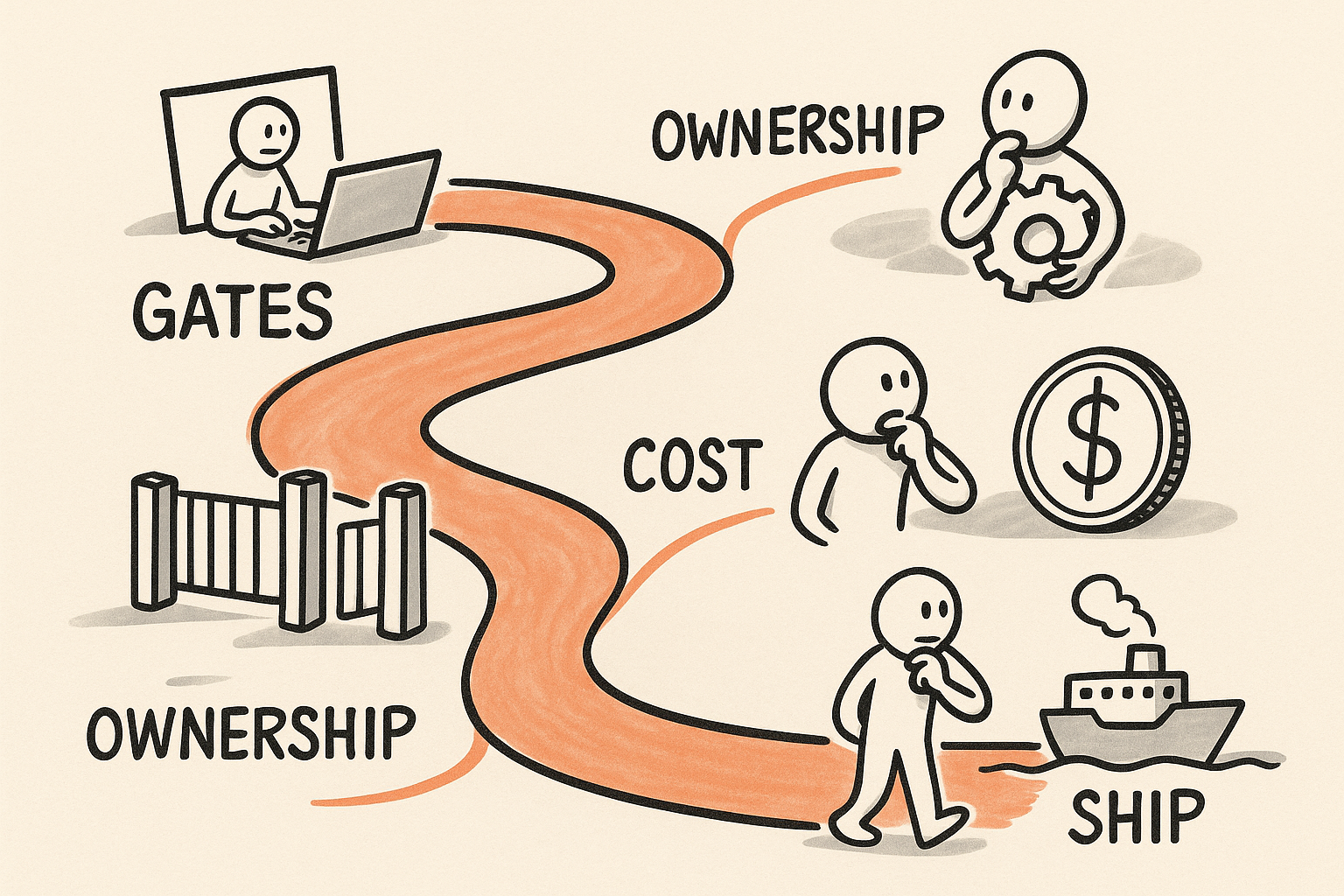
There is a new kind of confidence in teams right now. Someone can describe a product in plain English, get a working demo in hours, and call it “done”. It feels like shipping got solved.
Then the first real user arrives. Auth is leaky. Secrets are sitting in a repo. The data model cannot migrate. Logs are useless. Nobody can explain where half the code came from. The demo was fast, but delivery is still slow, just in a more chaotic way.
The mistake is thinking the problem is “code generation”. It is not. The problem is turning generated output into a product that can survive contact with customers, auditors, and your own on-call rotation. The answer is not more prompts. It is a software factory mindset, where “factory” means repeatable gates and clear accountability, not bureaucracy.
That is why the idea of bringing back software factories is interesting, especially the notion of submitting a vibe-coded app to a service that validates, tests, and mass-produces it in a repeatable way, as described in Why software factories are back, and how they work in the age of AI. Whether you buy a platform or build your own internal version, the pattern is the same: you do not trust the output, you trust the process.
1) Treat vibe code like untrusted input
Generated code is not “bad”. It is simply unpriced risk. It arrives without the normal trail of design decisions, tradeoffs, and reviews that make a system maintainable.
So start with a blunt policy:
- Everything produced by an AI is untrusted until it passes gates. The same way you treat inbound network traffic, uploaded files, or third-party packages.
- “Works on my machine” is not a state. The only state that matters is “passes the pipeline”.
This framing does two useful things. First, it removes shame from the conversation. Nobody needs to defend the code. Second, it makes your next decisions obvious: define the gates, then automate them until they are boring.
2) Build enforceable gates, not guidelines
Most teams already have “standards”. The problem is they are written like a document and enforced like a suggestion. Vibe coding amplifies that weakness because it floods the system with change.
What you want instead is a set of gates that are mechanically enforced. A change either passes or it does not.
The minimum gate set
- Tests: unit tests for logic, integration tests for boundaries, and at least one end-to-end test for the primary user journey. The goal is not coverage as a trophy. It is fast detection when a refactor breaks behavior.
- Security: static analysis, dependency scanning, and secrets detection. Also require a threat model for any feature that touches identity, payments, or sensitive data. Keep it lightweight, but make it mandatory.
- Provenance: a build that can answer: what commit produced this artifact, what dependencies did it include, and who approved it. If you cannot answer those questions in minutes, you do not have a release process, you have a ritual.
- Observability: structured logs, a few key metrics, and sane error handling. If you cannot see failure, you will debug by guessing, and incident load will climb.
The most important detail: gates must run by default. A manual checkbox creates exceptions, and exceptions become the real system.
I have written more about this idea from a different angle in Default-On Agentic Coding Is a Release Pipeline Change, Not a Feature Toggle. The principle is identical here: you are changing the release machinery, not adding a toy.
3) Draw ownership boundaries that survive speed
AI increases throughput. That is exactly why fuzzy ownership becomes dangerous. When change volume spikes, unclear boundaries turn into “everybody touched it, nobody owns it”.
A workable model is to separate what can be generated from what must be owned.
Define three zones
- Sandbox zone: prototypes, internal tools, throwaway spikes. Vibe coding is welcome. The cost of being wrong is low. Access is limited. Data is synthetic.
- Product zone: customer-facing code. Changes require the full gate set. This is where you invest in tests, migration discipline, and observability.
- Control zone: identity, billing, permissions, core data, and anything that can create legal or financial liability. This code changes slowly, with explicit review, and with rollback plans.
This zoning does not slow you down. It prevents a common failure mode where the fastest path becomes the only path, and suddenly your prototype shortcuts are sitting behind production auth.
One internal rule helps: only a named owner can move code from sandbox to product, and from product to control. Not a committee. A person accountable for the consequences.
4) Make “cost of change” visible, then price it into every decision
Vibe coding feels like speed because the first version is cheap. The trap is that the second and third versions often get more expensive, because nobody invested in the scaffolding that makes change safe.
You need a model for cost of change that is simple enough to use in weekly decisions.
A practical cost-of-change model
- Build cost: time to implement the feature.
- Change cost: time to modify it safely next month. This is dominated by test quality, clarity of interfaces, and data migration design.
- Failure cost: time spent debugging, incident response, customer support, reputational damage, and rework under pressure.
The compounding effect comes from this: AI reduces build cost, but it can raise change cost and failure cost unless you invest in gates and boundaries. If you only celebrate build cost, you will accidentally optimize for fragility.
A simple way to enforce the model is to add one question to your product and engineering handshake: “What is the rollback and the test plan?” If the answer is vague, you are not looking at a shippable change. You are looking at a demo.
This is also where formalization pays off. Not heavy specs, but just enough precision to prevent ambiguous behavior from becoming production ambiguity. I captured that mindset in Formal Specs Are Incident Tools, Not Academic Proofs.
5) Turn the factory into a service, then let teams move faster
The highest leverage move is to treat the release pipeline as a product. That means it has users (your engineers), it has uptime requirements (build reliability), and it has a roadmap (which gates to automate next).
When you do this well, a new pattern emerges:
- Teams generate more code.
- The pipeline rejects bad changes early.
- Fixes happen while context is fresh.
- Production becomes calmer even as throughput rises.
In practice, this looks like a “factory” that can ingest a repo, run validation, produce artifacts, and push deployable outputs, which mirrors the notion of a service that can validate and mass-produce vibe-coded apps in a repeatable way, as outlined in the ZDNET piece.
One caution: do not confuse automation with abdication. Your pipeline can run checks, but it cannot decide what risk is acceptable for your business. That is still your job.
A lived lesson: speed without gates is just deferred work
I once watched a team rebuild the same integration twice in quick succession because the first version “worked”, but had no meaningful tests and no contract at the boundary. Every change became a regression lottery. We did not have a talent problem. We had a discipline problem. The moment we added a real gate for integration tests and pinned the interface ownership to one person, the churn stopped.
This is the core point: AI will happily help you produce the first version of anything. Your advantage is being the kind of builder who can produce the tenth version without drowning.
Closing opinion: AI speed is real, but only compounds behind constraints
The best teams will not win by generating more code. They will win by making change cheap. That requires enforceable gates, clear ownership boundaries, and a visible cost-of-change model that shows the true price of shortcuts.
If you want one move to start this quarter: pick one product surface, declare the minimum gate set non-negotiable, and make the pipeline the only path to production. You will feel slower for a week. Then you will realize you can ship faster because you are no longer paying interest on fragile work.
Newsletter
Working notes, straight to your inbox.
Occasional, no-noise notes on leadership, execution, and applied AI — from the field, not the sidelines.