27 October 2026 · 8 min read
Would you finance an offshore data center on satellite and batteries?
Cool render, hard asset. The gap is not generation, it is maintainability, warranties, and a contract that survives bad weeks at sea.
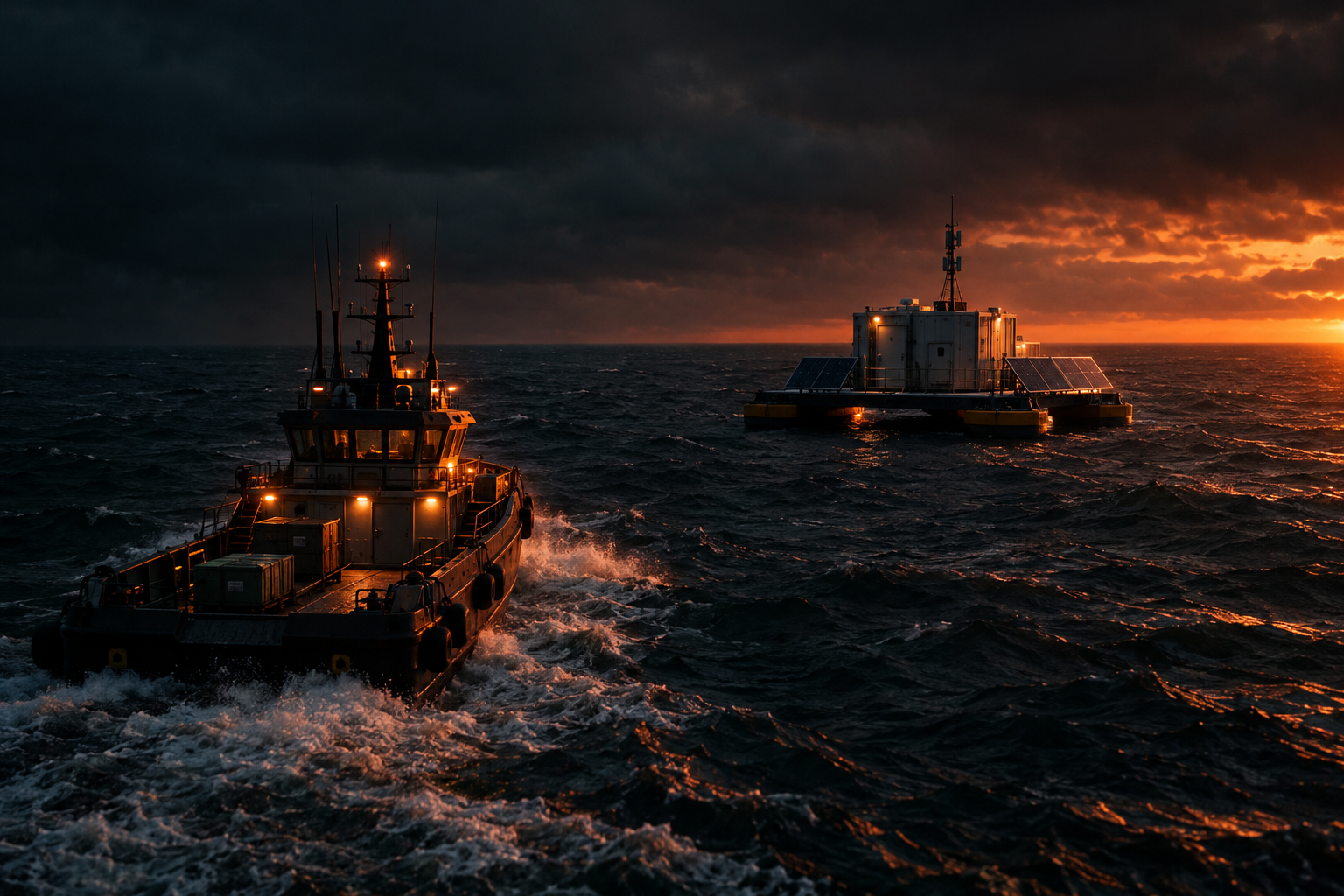
I like ambitious energy systems. I also know what happens when a beautiful concept meets salt, motion, and a service window that keeps getting cancelled.
That is why most “offshore data center + floating renewables + batteries” concepts feel like renders. They speak in kilowatts and modules, then go quiet where infrastructure actually gets judged: uptime, maintainability, spares, warranty terms, and who pays when reality shows up.
The trigger for this piece is a recent note on Mocean Energy’s plan to begin commercial deployments from 2030, combining modular offshore data centers with an offshore power system that includes floating solar and batteries. The concept also leans on low-Earth orbit satellite communications and targets 500 kW to 1 MW per unit without a grid connection. They report 18 months of full-scale offshore testing. Good. Testing is table stakes.
The adult question is: what fails first, and how do you write guarantees so a lender treats this like infrastructure instead of a prototype with a marketing department?
The first failures are boring: access, salt, and variance
If you are building compute at sea, your enemy is not a single catastrophic event. It is the accumulation of small degradations and delayed fixes.
In practice, the first pain usually shows up in six places.
- O&M logistics, not engineering. You will miss planned maintenance. You will get weathered out. You will have a technician on standby while the unit is unreachable. The cost is not the day rate. The cost is the backlog that forms behind every deferred task.
- Corrosion plus connectors plus human hands. Salt fog attacks the places you least want it: terminations, latches, cable glands, ground bonds. The hardware might be “marine grade” on paper. The weak point is where two parts meet, and where someone opens and closes something 40 times a year.
- Power quality and cycling. Batteries make off-grid possible. They also introduce a duty cycle that punishes components. Inverters, DC bus parts, contactors, and cooling fans do not age on calendar time, they age on stress and switching.
- Thermal management drift. Data center cooling assumptions come from stable platforms. Offshore means more vibration, more fouling, and more filters that clog earlier than your spreadsheet predicted. The penalty is not comfort. It is throttling and lost revenue capacity.
- Comms brittleness and remote hands illusions. Relying on LEO satellite communications is not crazy. Pretending it replaces local diagnostics and safe modes is. If your comms go flaky during a power event, you need the system to protect itself without waiting for a packet to arrive.
- Spares and warranty boundaries. The offshore twist is simple: every spare you did not preposition becomes downtime you cannot schedule. Every warranty that excludes “corrosive environment”, “improper maintenance”, or “abnormal cycling” becomes a finance problem.
None of these are sexy. That is exactly why they kill projects. People fall in love with the architecture and underinvest in the service reality.
Reliability is a design target, not a service promise
Here is the distinction that matters for financeability.
A service promise says: “we will fix it fast.” Offshore makes that an expensive lie.
A reliability target says: “it will keep working while you cannot touch it.” That changes everything: component selection, redundancy philosophy, sensing, and how you degrade gracefully.
If I were structuring an offshore compute unit, I would insist on three design principles.
- Single-fault tolerance where access is hard. If the part is behind a hatch that requires a boat and a calm day, do not make it a single point of failure. Duplicate it, derate it, or move it.
- Replaceability beats optimization. Modular is only meaningful if the module can be swapped in the real world. Not by a lab technician with a torque screwdriver, but by a field team with gloves, salt spray, and time pressure.
- Defined degradation modes. When energy is tight, do you shed load, reduce compute, or reduce cooling margin? Pick one. Automate it. Make it reversible. Do not let the system discover its own failure mode.
I learned this lesson the hard way years ago while supporting variable-speed drive applications in harsh environments: the headline spec rarely breaks first. The interface does. The maintenance assumption does. The “it will be fine” around connectors becomes the root cause that repeats.
Spares, diagnostics, and “mean time to shore”
If you want this to be treated like infrastructure, you need an explicit philosophy for parts and repair.
Onshore, the hidden assumption is “someone can bring the part tomorrow.” Offshore, the equivalent metric is “mean time to shore.” How long from fault detection to the unit being back at steady-state output?
To shrink that number, I would structure the system around four practices.
- Two-tier spares. Tier 1 is on the asset: the parts that most often fail and are safe to swap with a small crew (fans, filters, sensor packs, comms modules, power supplies). Tier 2 is onshore: heavier assemblies that require planning (inverter module, battery rack segments, cooling skid sections). If a Tier 1 spare is not physically on the unit, it is not a Tier 1 spare.
- Remote triage that ends in a decision. Your telemetry should answer: keep running, derate, or shut down. Not a dashboard. A decision. This is where a lot of “connected” products disappoint in real incidents.
- Configuration control like you mean it. If software and firmware can drift across a fleet, your troubleshooting becomes archaeology. That is not survivable when comms are limited and site visits are expensive. (This is also why I like the stance in Formal Specs Are Incident Tools, Not Academic Proofs, because incidents punish ambiguity.)
- Consumables as a contract line. Filters, sacrificial anodes, desiccants, seal kits. Put them in the plan, price them, and tie them to availability targets. Otherwise they become “somebody forgot” events.
Warranties that survive reality (and stop being fiction)
Most warranty language is written to protect the supplier. Project finance needs the opposite: predictable outcomes when something breaks.
If you are selling offshore compute capacity, you are effectively selling a bundle of risks. Energy intermittency, comms loss, salt, vibration, human error, component defects. You cannot wave those away. You have to allocate them.
This is how I would push to structure warranty and performance coverage so it becomes bankable.
1) Separate “energy availability” from “compute availability”
An off-grid unit will sometimes be energy constrained. That is not a failure, it is physics. Treat it explicitly.
- Energy availability guarantee: a metric tied to the offshore power system output and storage behavior, not to IT uptime. This is where you anchor the floating solar and batteries performance.
- Compute availability guarantee: a metric tied to delivered compute service when sufficient energy is available. This keeps the commercial promise honest.
Without this split, every discussion turns into blame. “The servers were down.” “No, the batteries were empty.” Finance hates blame. It wants formulas.
2) Pay liquidated damages in service credits, but cap the unbounded tail
Pure cash penalties can kill a young asset owner. Pure “best effort” credits are worthless to a buyer. The middle ground is service credits with a clear cap and escalation.
- Define a monthly availability target.
- Below target, credits apply automatically.
- Below a lower threshold, you trigger a remedy plan and potentially step-in rights.
- Beyond a defined cap, the buyer can terminate and the lender gets a controlled outcome.
This is not about being generous. It is about preventing a slow death where everyone keeps hoping next month will be better.
3) Write corrosion and cycling into the assumed duty, then warranty to it
Offshore corrosion is not “abuse.” Battery cycling is not “abnormal.” If your warranty excludes the core environment, it is not a warranty.
Make the duty profile explicit in the contract: salinity class, vibration envelope, cycling depth assumptions, comms outage tolerance. Then warrant against that declared reality.
4) Define maintainability KPIs, not just uptime
For offshore assets, the leading indicators matter more than the trailing ones. I would include:
- Remote recovery rate: percentage of incidents resolved without a visit.
- Deferred maintenance age: maximum allowed backlog for specified tasks.
- Mean time to shore: time from fault to stable output.
This is the difference between a system that is getting worse quietly and one that is being kept healthy.
The financing test: can you explain a bad month without a story?
People will fund almost anything if the contract turns chaos into numbers.
So here is my simple test for “cool render” versus “infrastructure”: when you have a bad month, can the asset owner, the buyer, and the lender all agree on what happened using the same dataset and the same formulas?
If the answer depends on interpretation, you will spend your life in meetings. If the answer is a spreadsheet anyone can audit, you can build a portfolio.
That is my stance on offshore data centers powered by floating renewables. The technical concept is plausible. The commercial concept will fail unless maintainability, duty profiles, and guarantee math get designed as carefully as the platform.
If you are building one of these, do not ask “can it work?” Ask “what will it cost to keep it working when we cannot reach it?” Then write that answer into the deal. Everything else is marketing.
Newsletter
Working notes, straight to your inbox.
Occasional, no-noise notes from inside the work: what shipped, what broke, and what I would do differently.